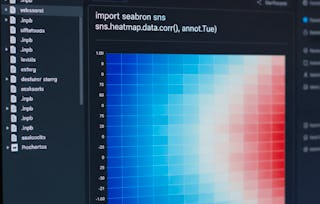
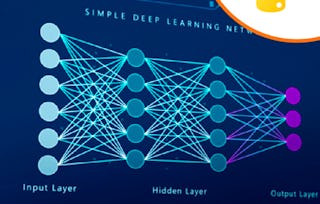
By the end of this course, learners will be able to analyze datasets, apply machine learning algorithms, evaluate classifiers, and implement deep learning models using Python and its popular frameworks. The course begins with the foundations of AI, covering essential concepts such as Python for AI, bias-variance tradeoff, and model evolution. Learners will then explore data handling, visualization, dimensionality reduction, and classifier evaluation to strengthen practical ML skills. Finally, the course dives into advanced AI with multilayer perceptrons, clustering, ensemble methods, and hands-on practice with TensorFlow, Keras, and PyTorch.

AI with Python: Apply & Implement ML Models

您将学到什么
Analyze datasets and apply key ML algorithms in Python.
Evaluate classifiers and perform dimensionality reduction.
Build deep learning models with TensorFlow, Keras, and PyTorch.
您将获得的技能
要了解的详细信息

可分享的证书
添加到您的领英档案
作业
11 项作业
授课语言:英语(English)
了解顶级公司的员工如何掌握热门技能

积累特定领域的专业知识
本课程是 Artificial Intelligence with Python: Foundations to Projects 专项课程 专项课程的一部分
在注册此课程时,您还会同时注册此专项课程。
- 向行业专家学习新概念
- 获得对主题或工具的基础理解
- 通过实践项目培养工作相关技能
- 获得可共享的职业证书


人们为什么选择 Coursera 来帮助自己实现职业发展

Felipe M.
自 2018开始学习的学生
''能够按照自己的速度和节奏学习课程是一次很棒的经历。只要符合自己的时间表和心情,我就可以学习。'

Jennifer J.
自 2020开始学习的学生
''我直接将从课程中学到的概念和技能应用到一个令人兴奋的新工作项目中。'

Larry W.
自 2021开始学习的学生
''如果我的大学不提供我需要的主题课程,Coursera 便是最好的去处之一。'

Chaitanya A.
''学习不仅仅是在工作中做的更好:它远不止于此。Coursera 让我无限制地学习。'
学生评论
- 5 stars
76.92%
- 4 stars
15.38%
- 3 stars
0%
- 2 stars
7.69%
- 1 star
0%
显示 3/13 个
PS
已于 Jan 8, 2026审阅
A very well-structured course that perfectly combines Python programming with AI fundamentals
KP
已于 Jan 14, 2026审阅
This course provides a clear and practical understanding of AI and machine learning using Python. The concepts are explained in a simple way, making it easy to apply them in real-world projects.
TS
已于 Jan 19, 2026审阅
A well-paced course that keeps learners motivated from start to finish.