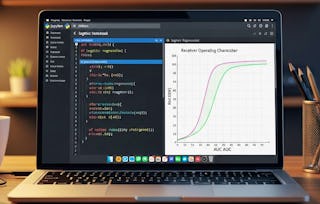
In this 4 week course, you will learn about Smart Beta products. Smart betas products have the characteristics of both passive investment(having predetermined rules) and active investments(allows for factor investment). We will walk through the creation mechanisms behind different smart beta products and recreate some of them using R programming. Then we will apply machine learning methods. Data processing, overfitting prevention techniques will be covered. Finally we will try to create an improved multi-factor model using CART, bagging, boosting and ensemble methods. Students are expected to have listened to my first and second course 'The Fundamental of Data-Driven Investment' and 'Using R for Regression and Machine Learning in Investment', or having equivalent knowledge in investment concepts and a firm grasp on R programming.

Machine Learning for Smart Beta

您将获得的技能
- Asset Management
- Data Preprocessing
- Financial Modeling
- Classification And Regression Tree (CART)
- Feature Engineering
- Machine Learning
- Supervised Learning
- Investments
- Statistical Machine Learning
- Investment Management
- Machine Learning Algorithms
- Data Processing
- Model Evaluation
- Applied Machine Learning
- Portfolio Management
您将学习的工具
要了解的详细信息

可分享的证书
添加到您的领英档案
作业
1 项作业
授课语言:英语(English)
了解顶级公司的员工如何掌握热门技能


人们为什么选择 Coursera 来帮助自己实现职业发展

Felipe M.
自 2018开始学习的学生
''能够按照自己的速度和节奏学习课程是一次很棒的经历。只要符合自己的时间表和心情,我就可以学习。'

Jennifer J.
自 2020开始学习的学生
''我直接将从课程中学到的概念和技能应用到一个令人兴奋的新工作项目中。'

Larry W.
自 2021开始学习的学生
''如果我的大学不提供我需要的主题课程,Coursera 便是最好的去处之一。'

Chaitanya A.
''学习不仅仅是在工作中做的更好:它远不止于此。Coursera 让我无限制地学习。'
从 Business 浏览更多内容

EDHEC Business School

Sungkyunkwan University

New York Institute of Finance