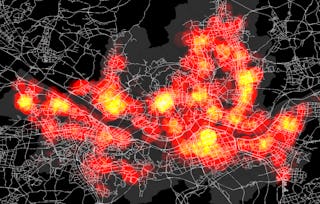
Spatial data is everywhere, but maps alone can be misleading. In Crunch Spatial Stats, you will move beyond visual patterns and use spatial statistics to make defensible, evidence-based conclusions from location-based data. Working with realistic air-quality examples, you will develop practical skills to test whether patterns are meaningful, estimate conditions between measurements, and explain how spatial relationships change with distance. The course emphasizes clear reasoning and interpretation, not complex mathematics, so you will confidently explain results to both technical and non-technical audiences.
By the end of this course, you will be able to compute Global Moran’s I for a polygon layer, perform IDW interpolation for point observations, and interpret semivariograms to assess spatial autocorrelation.
Throughout the course, you will practice skills commonly used in environmental monitoring, public health, and spatial analysis roles, focusing on understanding the assumptions and limitations behind each method. This course is designed for beginners. You will need basic familiarity with maps, tabular datasets, and simple descriptive statistics. No prior experience with spatial statistics or geostatistical modeling is required.
In this module, you will explore how spatial patterns differ from random distributions and why that difference matters in real-world analysis. Using air-quality sensor data as a motivating example, you will examine how Global Moran’s I quantifies spatial autocorrelation in polygon data and helps analysts identify clustering patterns that might otherwise go unnoticed.
涵盖的内容
2个视频2篇阅读材料2个作业
显示有关单元内容的信息
2个视频•总计9分钟
Welcome and Course Introduction•4分钟
Global Moran’s I Explained: Measuring Spatial Autocorrelation•5分钟
2篇阅读材料•总计18分钟
Understanding Global Moran’s I in Polygon-Based Spatial Data•8分钟
Walkthrough: How to Compute Global Moran’s I in R•10分钟
2个作业•总计25分钟
Hands-On Learning: Compute Global Moran’s I for Air-Quality Zones•15分钟
Practice Quiz: Interpreting Global Moran’s I Results•10分钟
Estimating Surfaces with IDW Interpolation
第 2 单元•小时 后完成
单元详情
In this module, you will examine how spatial analysts estimate values between discrete measurement locations. Using air-quality sensor data as a motivating example, you will be introduced to Inverse Distance Weighting (IDW) interpolation and learn how distance-based assumptions are used to generate continuous surfaces from point observations. You will explore how parameter choices influence interpolation results and learn how to interpret estimated surfaces responsibly in real-world spatial analysis contexts.
涵盖的内容
2个视频2篇阅读材料2个作业
显示有关单元内容的信息
2个视频•总计10分钟
From Points to Surfaces: Why Interpolation Matters•5分钟
How IDW Interpolation Works for Spatial Prediction•6分钟
2篇阅读材料•总计14分钟
When and Why to Use IDW Interpolation•8分钟
Walkthrough: How to Implement and Plot IDW in R•6分钟
2个作业•总计30分钟
Hands-On Learning: Create an IDW Hotspot Map from Sensor Data•20分钟
Practice Quiz: Choosing and Evaluating IDW Interpolation Outputs•10分钟
Understanding Spatial Autocorrelation with Semivariograms
第 3 单元•小时 后完成
单元详情
In this module, you will step back from computation to interpretation, focusing on semivariograms as diagnostic tools for spatial structure. By learning how to read range, sill, and nugget, you will gain intuition about spatial dependence, knowledge that informs both analysis choices and communication with non-technical audiences.
涵盖的内容
3个视频2篇阅读材料2个作业
显示有关单元内容的信息
3个视频•总计13分钟
Why Distance Matters: Introducing the Semivariogram•5分钟
Interpreting Nugget, Sill, and Range in Semivariograms•5分钟
Congratulations and Continuous Learning Journey•3分钟
2篇阅读材料•总计14分钟
How Semivariograms Describe Spatial Autocorrelation•8分钟
Walkthrough: How to Assess a Semivariogram•6分钟
2个作业•总计35分钟
Graded Assessment: Assessing Spatial Autocorrelation and Hotspot Mapping Decisions•20分钟
Hands-On Learning: Interpret Semivariograms to Assess Spatial Autocorrelation•15分钟
Coursera brings together a diverse network of subject matter experts who have demonstrated their expertise through professional industry experience or strong academic backgrounds. These instructors design and teach courses that make practical, career-relevant skills accessible to learners worldwide.
When will I have access to the lectures and assignments?
To access the course materials, assignments and to earn a Certificate, you will need to purchase the Certificate experience when you enroll in a course. You can try a Free Trial instead, or apply for Financial Aid. The course may offer 'Full Course, No Certificate' instead. This option lets you see all course materials, submit required assessments, and get a final grade. This also means that you will not be able to purchase a Certificate experience.
What will I get if I subscribe to this Specialization?
When you enroll in the course, you get access to all of the courses in the Specialization, and you earn a certificate when you complete the work. Your electronic Certificate will be added to your Accomplishments page - from there, you can print your Certificate or add it to your LinkedIn profile.
Is financial aid available?
Yes. In select learning programs, you can apply for financial aid or a scholarship if you can’t afford the enrollment fee. If fin aid or scholarship is available for your learning program selection, you’ll find a link to apply on the description page.