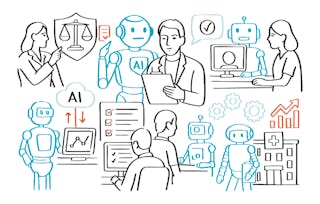
This hands-on course focuses on implementing AI-powered automation solutions for clinical workflows. Learners gain practical experience with Azure AI services for clinical documentation, medical text processing, anomaly detection, and intelligent monitoring systems. You learn to integrate multiple AI services to create comprehensive workflow automation solutions that enhance clinical efficiency and care quality. This course is designed for healthcare professionals, IT professionals in healthcare organizations, and career changers seeking to leverage AI and cloud technologies in healthcare settings, with basic cloud computing knowledge, SQL familiarity, and understanding of healthcare workflows. Throughout the course, participants will master the deployment of speech transcription services that convert clinical conversations into accurate documentation, significantly reducing administrative burden. You'll design robust anomaly detection systems capable of generating timely clinical alerts based on patient monitoring data, enabling proactive intervention. The course also covers the critical skill of creating AI output monitoring frameworks to ensure the quality, reliability, and accuracy of automated systems in healthcare settings. Learners will gain hands-on experience evaluating and optimizing AI-powered workflows, applying best practices to balance automation efficiency with clinical accuracy. By the end of the course, you'll be equipped to architect end-to-end solutions that seamlessly combine multiple Azure AI services, transforming clinical operations while maintaining the highest standards of patient care.

Clinical Workflow Automation and AI Integration

本课程是 Microsoft Azure AI in Healthcare 专业证书 的一部分

位教师: Microsoft
访问权限由 Coursera Learning Team 提供
您将学到什么
Implement Azure AI services, including NLP and speech tools, for clinical documentation and text analysis.
Design and integrate AI-driven systems for patient monitoring, anomaly detection, and clinical alerts.
Evaluate and optimize automated clinical workflows to ensure efficiency, accuracy, and reliability.
您将获得的技能
- Microsoft Azure
- Regulatory Compliance
- Anomaly Detection
- Health Technology
- Clinical Monitoring
- Continuous Monitoring
- Generative AI
- Medical Equipment and Technology
- Real Time Data
- Natural Language Processing
- Clinical Informatics
- Health Informatics
- Unstructured Data
- Speech Language Pathology
- Quality Assurance
- Clinical Documentation
- Responsible AI
- 技能部分已折叠。显示 9 项技能,共 17 项。
要了解的详细信息
了解顶级公司的员工如何掌握热门技能

积累 Healthcare Management 领域的专业知识
- 向行业专家学习新概念
- 获得对主题或工具的基础理解
- 通过实践项目培养工作相关技能
- 通过 Microsoft 获得可共享的职业证书

该课程共有4个模块
This foundational module introduces learners to the core technologies and techniques for automating clinical documentation processes. Students gain hands-on experience with Azure Text Analytics for Health, Dragon Medical One, Azure Speech Services, and natural language processing technologies specifically designed for healthcare environments. The module focuses on transforming unstructured clinical narratives into structured, actionable data while maintaining accuracy and clinical context. Learners explore the integration of speech recognition, entity extraction, and medical terminology processing to create comprehensive documentation workflows that enhance efficiency and reduce administrative burden.
涵盖的内容
6个视频6篇阅读材料4个作业
This intermediate module advances learners' skills in sophisticated text processing techniques tailored for healthcare environments. Students explore generative AI applications for clinical summarization, automated medical document classification systems, and the integration of multiple AI services into cohesive workflows. The module emphasizes multi-document analysis, advanced prompt engineering, and the creation of intelligent systems that can process complex clinical narratives across various document types. Learners develop expertise in handling lengthy clinical texts, maintaining medical accuracy, and designing quality assurance processes for AI-generated outputs.
涵盖的内容
6个视频6篇阅读材料4个作业
This advanced module focuses on implementing intelligent monitoring systems that can detect patterns and anomalies in patient data to support clinical decision-making. Students learn to configure Power BI's built-in AI anomaly detection features (powered by Azure AI) for physiological parameters, design sophisticated alert generation workflows, and create real-time monitoring systems that integrate with existing clinical infrastructure. The module emphasizes the balance between sensitivity and specificity in clinical alerting, strategies for reducing alert fatigue, and the development of intelligent escalation protocols that ensure critical information reaches the right clinicians at the right time.
涵盖的内容
6个视频6篇阅读材料4个作业
This capstone module addresses the critical aspects of maintaining safe, effective, and reliable AI systems in healthcare production environments. Students learn to implement comprehensive monitoring frameworks using Azure Responsible AI tools, design quality assurance processes that ensure consistent performance, and create feedback mechanisms for continuous system improvement. The module covers regulatory compliance, audit trail management, fairness monitoring, and the integration of AI systems with existing healthcare information systems. Learners develop expertise in establishing governance frameworks that balance innovation with patient safety and regulatory requirements.
涵盖的内容
6个视频6篇阅读材料5个作业
获得职业证书
将此证书添加到您的 LinkedIn 个人资料、简历或履历中。在社交媒体和绩效考核中分享。
人们为什么选择 Coursera 来帮助自己实现职业发展

Felipe M.

Jennifer J.

Larry W.

Chaitanya A.
从 Health 浏览更多内容
¹ 本课程的部分作业采用 AI 评分。对于这些作业,将根据 Coursera 隐私声明使用您的数据。