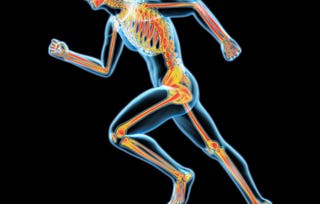
This course will take you through the kinematics of human locomotion including modeling upright walking as a controlled fall, how muscles and bones work together to move individuals using a series of joints and levers, and how the abductor mechanism works to solve the “seesaw problem” of side-to-side wobbling. You will also understand how paleoanthropologists look for musculoskeletal adaptations in fossils to reconstruct how something in the past moved. You’ll explore how musculoskeletal adaptations correlate with bipedalism, as well as what significance these clues hold for telling us about how hominins moved. Additionally, you will learn the kinematics of other habitual striding bipeds found in the animal kingdom.
Every module of this course has been created with the intention of a “hands-on” learner experience, where you can play around with and learn from 3D renditions of different human and animal fossils. Through these exercises, you will be able to observe and describe animal behavior in order to explain the function of their locomotion and how that relates to our own.
This module provides an introduction to the kinematics of human locomotion and the musculoskeletal adaptations for bipedalism.
涵盖的内容
11个视频11篇阅读材料1个作业2个讨论话题6个插件
显示有关单元内容的信息
11个视频•总计19分钟
Video: Introduction•1分钟
Video: Kinematics of Walking•1分钟
Video: Controlled Fall•2分钟
Video: Skeletons Can't Walk•4分钟
Video: Abductor Mechanism•2分钟
Video: Musculoskeletal Adaptations•1分钟
Video: The Head•1分钟
Video: The Back•1分钟
Video: The Pelvis•3分钟
Video: The Knee•1分钟
Video: The Foot•1分钟
11篇阅读材料•总计109分钟
Introductory Reading•10分钟
Syllabus•30分钟
Book: First Steps: How Upright Walking Made Us Human•10分钟
Coursera Code of Conduct•10分钟
Coursera Honor Code•10分钟
Discussion Tips and Guide•10分钟
Learning Journal•10分钟
Overview•10分钟
Musculoskeletal Adaptations•1分钟
3D Models: Comparing the Pelvis and Femur in Chimps and Humans•5分钟
3D Models: Comparing Chimpanzee and Human Feet•3分钟
1个作业•总计30分钟
Bipedalism and Musculoskeletal Adaptations•30分钟
2个讨论话题•总计40分钟
Introduce Yourself•30分钟
Learning Journal: My Goals•10分钟
6个插件•总计30分钟
Chimp Femur •5分钟
Human Femur•5分钟
Chimpanzee Pelvis •5分钟
Human Female Pelvis •5分钟
Chimp Foot •5分钟
Human Foot •5分钟
Module 2: More About the Mechanics of Bipedalism
第 2 单元•小时 后完成
单元详情
This module explores how other bipedal walkers move uniquely.
涵盖的内容
5个视频1篇阅读材料1个作业2个讨论话题
显示有关单元内容的信息
5个视频•总计19分钟
Video: Other Bipedal Walkers•1分钟
Video: Convergent Evolution•1分钟
Video: Bipedalism in Other Mammals•2分钟
Video: Bears•12分钟
Video: Emus•2分钟
1篇阅读材料•总计60分钟
Explore More: Mechanics of Bipedalism•60分钟
1个作业•总计30分钟
More About the Mechanics of Bipedalism•30分钟
2个讨论话题•总计40分钟
Discussion•10分钟
Learning Journal•30分钟
Module 3: The Origins of Bipedalism and its Evolution
第 3 单元•小时 后完成
单元详情
This module provides an overview of human evolution and explores the origin of bipedalism.
涵盖的内容
17个视频7篇阅读材料1个作业2个讨论话题18个插件
显示有关单元内容的信息
17个视频•总计27分钟
Video: Introduction•1分钟
Video: An Introduction to Human Evolution•2分钟
Video: Last Common Ancestor•2分钟
Video: Science and Human Evolution•2分钟
Video: Hominins•3分钟
Video: Earliest Fossil Bipeds•1分钟
Video: Lucy•3分钟
Video: Early Fossil Evidence for Bipedalism•2分钟
Video: Ardipithecus kadabba•1分钟
Video: Ardipithecus ramidus•2分钟
Video: Models of Bipedal Origins•1分钟
Video: A Generalized Ape•2分钟
Video: Bipedalism in the Trees•1分钟
Video: Why Bipedalism Evolved•1分钟
Video: Aggressive Hunters•2分钟
Video: Chimpanzee Bipedalism•2分钟
Video: The Mystery Remains•1分钟
7篇阅读材料•总计37分钟
Overview•10分钟
3D Fossils: Comparing Hominin Skulls•5分钟
3D Models: Lucy and Laetoli•5分钟
3D Model: Earliest Evidence for Bipedalism•5分钟
3D Models: Ardipithecus ramidus•5分钟
3D Models: Aggressive Hunters•5分钟
Explore More•2分钟
1个作业•总计30分钟
The Origins of Bipedalism and its Evolution•30分钟
2个讨论话题•总计40分钟
Discussion•10分钟
Learning Journal•30分钟
18个插件•总计90分钟
Comparing Hominin Skulls: Toumai •5分钟
Comparing Hominin Skulls: Mrs. Ples •5分钟
Comparing Hominin Skulls: Homo erectus (D2282) •5分钟
Founded in 1769, Dartmouth is a member of the Ivy League and consistently ranks among the world’s greatest academic institutions. Dartmouth has forged a singular identity for combining its deep commitment to outstanding undergraduate liberal arts and graduate education with distinguished research and scholarship in the Arts and Sciences and its four leading graduate schools—the Geisel School of Medicine, the Guarini School of Graduate and Advanced Studies, Thayer School of Engineering, and the Tuck School of Business.
When will I have access to the lectures and assignments?
To access the course materials, assignments and to earn a Certificate, you will need to purchase the Certificate experience when you enroll in a course. You can try a Free Trial instead, or apply for Financial Aid. The course may offer 'Full Course, No Certificate' instead. This option lets you see all course materials, submit required assessments, and get a final grade. This also means that you will not be able to purchase a Certificate experience.
What will I get if I subscribe to this Specialization?
When you enroll in the course, you get access to all of the courses in the Specialization, and you earn a certificate when you complete the work. Your electronic Certificate will be added to your Accomplishments page - from there, you can print your Certificate or add it to your LinkedIn profile.
Is financial aid available?
Yes. In select learning programs, you can apply for financial aid or a scholarship if you can’t afford the enrollment fee. If fin aid or scholarship is available for your learning program selection, you’ll find a link to apply on the description page.