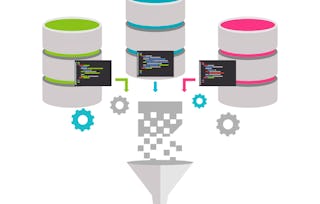
This course introduces the principles and practice of Extract-Transform-Load (ETL) systems—the backbone of modern data-driven operations. Learners begin by exploring database fundamentals, including schemas, tables, and source structures, and then examine how ETL pipelines move, clean, and shape data for reliable use across analytics and AI workflows. Building on this foundation, the course provides hands-on experience using Apache NiFi to construct visual, end-to-end ETL flows, guiding learners through essential tasks such as extracting raw data from multiple sources, applying meaningful transformations, enriching records, standardizing formats, and loading clean results into destination systems. Each module builds practical fluency: from understanding core ETL concepts, designing extract–transform–load pipelines, to applying automation, optimization, and AI-supported improvements.

您将学到什么
Explain the core concepts, architecture, and role of ETL within modern data ecosystems.
Design and implement complete ETL workflows using Apache NiFi, applying extract, transform, and load functions on structured datasets.
Evaluate and optimize ETL pipelines for performance, reliability, and integration with AI or analytics systems.
您将获得的技能
要了解的详细信息

添加到您的领英档案
February 2026
1 项作业
了解顶级公司的员工如何掌握热门技能

该课程共有3个模块
This module introduces learners to the foundations of ETL by explaining why reliable data movement begins with understanding databases, schemas, and source structures. Through a guided Apache NiFi walkthrough, learners learn how to open the workspace, connect to a database, inspect tables, and preview real data. The module builds a consistent, team-wide approach to exploring source data—laying the groundwork for accurate extraction, transformation, and loading in later modules.
涵盖的内容
4个视频2篇阅读材料1次同伴评审
This module guides learners through the full ETL workflow by breaking it into its core stages—extract, transform, and load—and demonstrating how each step ensures data reliability. Through hands-on activities in Apache NiFi, learners build a simple end-to-end pipeline that pulls raw data, cleans and enriches it, and loads it into a structured destination. The module emphasizes consistency, automation, and validation so learners can design repeatable pipelines that support accurate analytics and downstream systems.
涵盖的内容
3个视频1篇阅读材料1次同伴评审
This module focuses on real-world ETL challenges, guiding learners through the process of identifying and diagnosing performance issues that arise as data volumes increase. It introduces practical optimization strategies—including tuning concurrency, improving transformation efficiency, and refining data flow design—to strengthen pipeline reliability and throughput. Learners also explore how AI can support smarter monitoring and optimization, preparing them to manage and enhance ETL workflows in production environments.
涵盖的内容
4个视频1篇阅读材料1个作业2次同伴评审
提供方
从 Data Analysis 浏览更多内容
状态:免费试用
状态:免费试用

人们为什么选择 Coursera 来帮助自己实现职业发展

Felipe M.

Jennifer J.

Larry W.

Chaitanya A.
常见问题
To access the course materials, assignments and to earn a Certificate, you will need to purchase the Certificate experience when you enroll in a course. You can try a Free Trial instead, or apply for Financial Aid. The course may offer 'Full Course, No Certificate' instead. This option lets you see all course materials, submit required assessments, and get a final grade. This also means that you will not be able to purchase a Certificate experience.
When you purchase a Certificate you get access to all course materials, including graded assignments. Upon completing the course, your electronic Certificate will be added to your Accomplishments page - from there, you can print your Certificate or add it to your LinkedIn profile.
Yes. In select learning programs, you can apply for financial aid or a scholarship if you can’t afford the enrollment fee. If fin aid or scholarship is available for your learning program selection, you’ll find a link to apply on the description page.
更多问题
提供助学金,