Northeastern University

Data Management in Healthcare

享受 3 個月的 Coursera Plus 40% 的折扣,節省讓您 閃耀的技能。立即保存

Northeastern University

Data Management in Healthcare

Jamon Foster

位教师:Jamon Foster

包含在 Coursera Plus

深入了解一个主题并学习基础知识。
9 小时 完成
灵活的计划
自行安排学习进度
深入了解一个主题并学习基础知识。
9 小时 完成
灵活的计划
自行安排学习进度

要了解的详细信息

可分享的证书

添加到您的领英档案

最近已更新!

May 2026

作业

4 项作业

授课语言:英语(English)

了解顶级公司的员工如何掌握热门技能

Petrobras, TATA, Danone, Capgemini, P&G 和 L'Oreal 的徽标

该课程共有4个模块

Welcome to Data Management in Healthcare! Before we can understand healthcare information systems, we need to understand the environment they operate in — and the data those systems are built to manage. Healthcare generates enormous amounts of data: clinical, financial, regulatory, and operational. But healthcare data isn't like data in other industries. Errors don't just cause inconvenience — they can harm or kill patients. Fragmentation isn't just inefficient — it's a structural feature of how the U.S. system is organized. And governance isn't optional — it's a regulatory and safety imperative. In this module, you'll explore what makes healthcare data unique, how data flows across the ecosystem, and what it takes to manage that data well.

涵盖的内容

1个视频9篇阅读材料1个作业1个应用程序项目

Now that you understand the data itself, let's go inside the provider organization. Hospitals and clinics operate dozens of interconnected information systems — from clinical documentation to laboratory results to medication dispensing to radiology imaging to billing. How do these systems work? How do they connect? And when they don't connect well, what happens? In this module, you'll trace data from patient registration through discharge, learn to distinguish between the types of records and systems involved, and understand the strategic decisions organizations make when building their information architecture.

涵盖的内容

7篇阅读材料1个作业

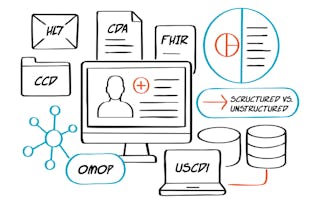
You've learned what data healthcare systems manage and what those systems look like individually. Now comes the hardest part: making them talk to each other. In this module, you'll go inside the "plumbing" — the integration infrastructure that allows a hospital's 50–100 systems to communicate. You'll learn the architectural patterns that determine how systems connect, the messaging standards that power clinical workflows, the imaging standard that enables radiology, the modern API-based standard that's reshaping the field, and the terminologies that ensure systems actually understand the data they're exchanging.

涵盖的内容

9篇阅读材料1个作业

Modules 1–3 focused on data within the provider world. But healthcare data flows far beyond the hospital or clinic — to insurance companies, regulators, employers, pharmacies, and directly to patients and their apps. In this final module, you'll follow the data as it crosses organizational boundaries: from provider to payer through standardized administrative transactions, through clearinghouses that facilitate that exchange, and directly to patients through modern APIs. You'll also examine the regulatory landscape that governs this exchange — including the landmark Information Blocking provisions that prohibit practices restricting patient access to their own data.

涵盖的内容

10篇阅读材料1个作业

位教师

Jamon Foster
Northeastern University
1 门课程3 名学生

提供方

从 Data Management 浏览更多内容

人们为什么选择 Coursera 来帮助自己实现职业发展

Felipe M.

自 2018开始学习的学生
''能够按照自己的速度和节奏学习课程是一次很棒的经历。只要符合自己的时间表和心情,我就可以学习。'

Jennifer J.

自 2020开始学习的学生
''我直接将从课程中学到的概念和技能应用到一个令人兴奋的新工作项目中。'

Larry W.

自 2021开始学习的学生
''如果我的大学不提供我需要的主题课程,Coursera 便是最好的去处之一。'

Chaitanya A.

''学习不仅仅是在工作中做的更好:它远不止于此。Coursera 让我无限制地学习。'

常见问题