


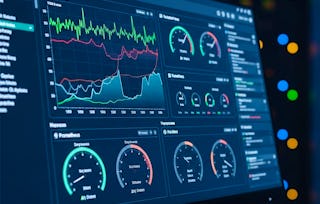
Modern software systems are complex, distributed, and always on which makes monitoring a critical skill for any engineer. This course equips developers, SREs, and IT professionals with the ability to build a complete monitoring stack using Prometheus and Grafana. Starting from the basics of exporters and metric collection, learners will gain hands-on experience installing and configuring Prometheus in a Linux environment. They will then master PromQL, the powerful query language that transforms raw time-series data into actionable insights. Moving beyond queries, the course introduces alerting rules and Alertmanager, enabling proactive detection of anomalies and faster incident response. Finally, learners will integrate Prometheus with Grafana to design intuitive dashboards that bring clarity to complex systems and support real-world troubleshooting.

Advanced Prometheus Alerting and Monitoring
通过 Coursera Plus 提高技能,仅需 239 美元/年(原价 399 美元)。立即节省

您将学到什么
Configure Prometheus architecture to reliably collect, store, and query metrics in modern infrastructure environments.
Master PromQL to construct advanced queries that extract meaningful insights from time-series data.
Design effective alerting rules to proactively detect anomalies, ensure reliability, and reduce mean time to resolution (MTTR).
您将获得的技能
要了解的详细信息
了解顶级公司的员工如何掌握热门技能


从 Support and Operations 浏览更多内容



人们为什么选择 Coursera 来帮助自己实现职业发展

Felipe M.
自 2018开始学习的学生
''能够按照自己的速度和节奏学习课程是一次很棒的经历。只要符合自己的时间表和心情,我就可以学习。'

Jennifer J.
自 2020开始学习的学生
''我直接将从课程中学到的概念和技能应用到一个令人兴奋的新工作项目中。'

Larry W.
自 2021开始学习的学生
''如果我的大学不提供我需要的主题课程,Coursera 便是最好的去处之一。'

Chaitanya A.
''学习不仅仅是在工作中做的更好:它远不止于此。Coursera 让我无限制地学习。'

¹ 本课程的部分作业采用 AI 评分。对于这些作业,将根据 Coursera 隐私声明使用您的数据。