How to Make a Project Plan in 4 Steps
A project plan contains the schedule, tasks, roles and other key information of a professional project.
![[Featured image] A project manager in a dark shirt stands in front of a whiteboard with their arms crossed.](https://d3njjcbhbojbot.cloudfront.net/api/utilities/v1/imageproxy/https://images.ctfassets.net/wp1lcwdav1p1/A9UwG2OCkvf85ROChq8GG/e8b53055a7c8e276945dba1e712485a1/GettyImages-1197547359__4_.jpg?w=1500&h=680&q=60&fit=fill&f=faces&fm=jpg&fl=progressive&auto=format%2Ccompress&dpr=1&w=1000)
What is project planning?
Project planning refers to the phase in project management in which you determine the actual steps to complete a project. This includes laying out timelines, establishing the budget, setting milestones, assessing risks, and solidifying tasks and assigning them to team members.
Project planning is the second stage of the project management lifecycle. The full cycle includes initiation, planning, execution and closing.
What is a project plan?
A project plan is a document that lays out the key information of a project. This can vary depending on the organisation and project. The components of a project plan typically clarify:
Scope and goals: A project plan should make clear what the project is aiming to achieve.
Schedule: The schedule outlines when the project will start and end, how long tasks are expected to take and when milestones should be reached.
Tasks and milestones: Tasks are the components of work that must be completed to achieve milestones and eventually the entire project. Milestones are a set of tasks that define the end of a phase of the project. For example, completing a website prototype in a project to redesign a company’s website would be considered a milestone.
People: A project plan generally defines which individual is in charge of what task.
Documentation: A project plan might include links to other important charts and documents, like RACI charts, a project charter, budget, or risk management plan, so that it is easy to find key information.
Project plan template
A template can provide project managers with a starting point that they can customise to their needs. Many are available for free download online like this project plan template, from the Google Project Management: Professional Certificate, which uses Google sheets. Other templates use Microsoft Word, Google Docs, or Microsoft Excel.
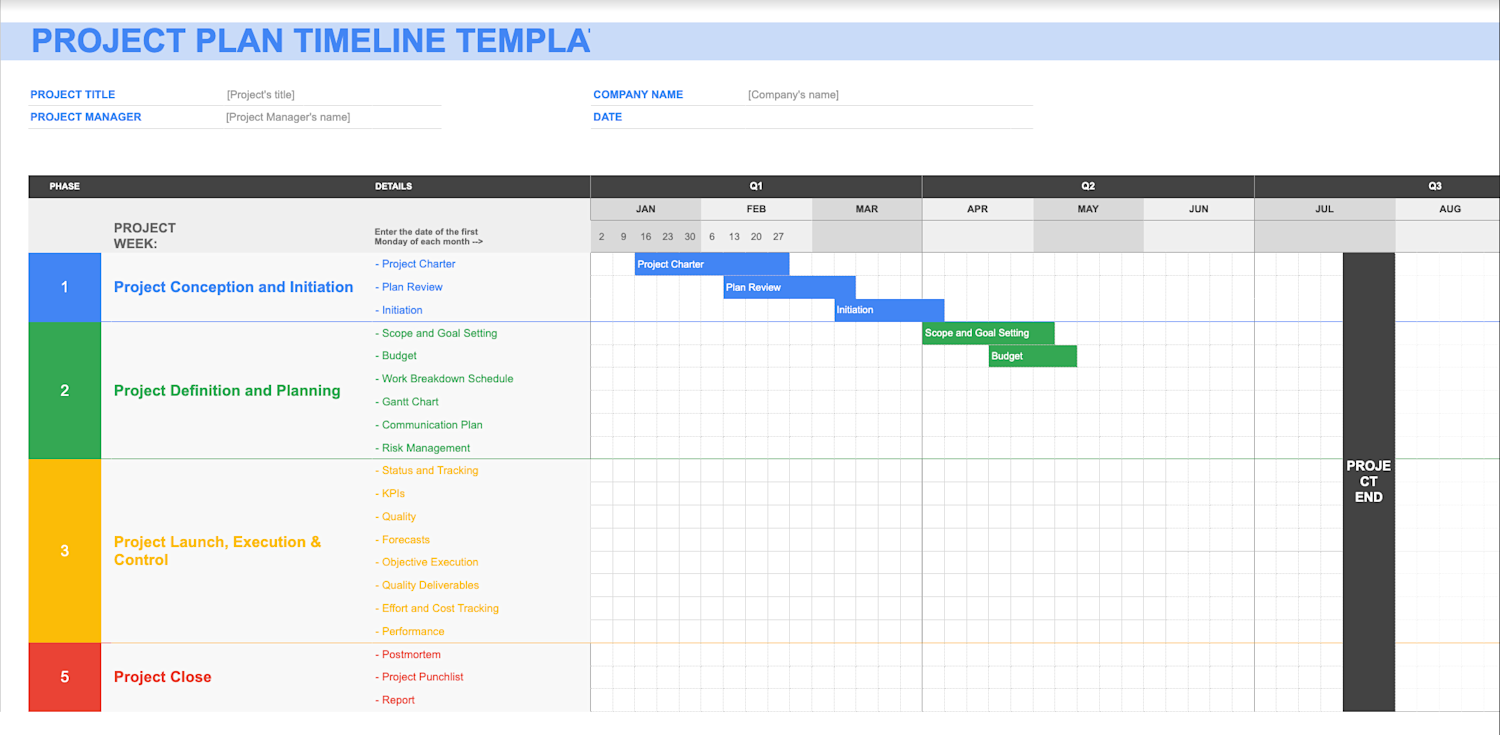
Image from Google Project Management: Professional Certificate.
How to create a project plan
Your exact project plan might look different depending on the preferences of the project manager and the organisation. Generally, however, you can start with determining your timeline before going on to solidify tasks, milestones, and roles and compiling other important documents.
1. Determine a timeline.
The cornerstone of the project plan is often the timeline or schedule. A timeline should include the date you will begin and expect to end the project, how long it will take to finish each task and milestone, and the dates you expect tasks and milestones to be completed.
Project managers often begin creating schedules around hard constraints determined by stakeholders. Do you need to design and produce a new toy before the holiday shopping season? You will want to make sure your schedule reflects this. Be sure to speak with team members to get a sense of how long each task typically takes. You may also want to include time buffers for tasks that involve some risk.
Tools at this stage you can use include:
Gantt chart
Work breakdown structure
2. Build out tasks and milestones.
Once you know when tasks, milestones, and the whole project should be completed, you can determine what resources are needed at what point in the project and which of your team members will work on each task. This exercise is called capacity planning.
You can also use this time to determine the critical path in a project. The critical path is the bare minimum of tasks you must complete to meet the project goal.
3. Establish roles.
In this phase, solidify the tasks each team member is assigned, and communicate with them to make sure they are informed and have their questions answered.
If you have created a RACI chart in the project initiation phase, this will be a good time to refer to it.
What does RACI stand for?
RACI is an acronym. It stands for responsible, accountable, consulted, and informed. A RACI chart is sometimes referred to as a RACI matrix or responsibility assignment matrix. They are used to track the roles and responsibilities in each stage of a project plan.

4. Link to important documents.
A project plan often becomes a central document referred to often as the project progresses. It might be a good idea to attach or link documents that will be useful to have on hand. If your project plan is in a spreadsheet, you might link to other documents in separate tabs for easy access.
Important documents might include:
Project charter
Project budget
Communication plan
RACI chart
Risk management plan
Change management plan
Getting started in project management
Creating a project plan is one step in ensuring that a project is carried out successfully. There are many other tools and phases you will want to have some knowledge of as you pioneer your first project.
If you are looking for a way to learn project management essentials, consider the Google Project Management: Professional Certificate. The first week is free.
Frequently asked questions (FAQ)
继续阅读
- November 29, 2023
- November 29, 2023
- November 29, 2023
Coursera Staff
编辑团队
Coursera 的编辑团队由经验丰富的专业编辑、作者和事实核查人员组成。我们的文章都经过深入研究和全面审核,以确保为任何主题提供值得信赖的信息和建议。我们深知,在您的教育或职业生涯中迈出下一步时可能...
此内容仅供参考。建议学生多做研究,确保所追求的课程和其他证书符合他们的个人、专业和财务目标。