Lorsque vous vous inscrivez à ce cours, vous êtes également inscrit(e) à cette Spécialisation.
Apprenez de nouveaux concepts auprès d'experts du secteur
Acquérez une compréhension de base d'un sujet ou d'un outil
Développez des compétences professionnelles avec des projets pratiques
Obtenez un certificat professionnel partageable
Il y a 4 modules dans ce cours
Humans are amazing sensors! This course will help you understand our sensing capabilities including taste, olfaction, tactile senses, vision, and audition. The course will explain at a high-level the anatomy, physiology, and chemistry of the senses and give you an appreciation of how senses are transmitted to, and experienced by, the brain. You’ll learn by experience to assess cases such as dysfunctions in olfaction or tactile temperature adaptation. Optional podcast conversations with experts in the field are included each week to provide additional insight on our senses and sensory research.
In this module, we will begin our discussion on the senses starting with taste. We will also discuss primary tastes, anatomy, physiology, and chemistry of taste. We will then touch on transducer and neural effects including receptor types, stimulus-receptor transducer mechanisms, neural channels, neural codes, and cortical cell types and mechanisms. We will do an activity on taste adaptation and finish the module with an optional podcast conversation with Joel Sidel. Let's get started.
Inclus
11 vidéos7 lectures1 devoir4 sujets de discussion
Afficher les informations sur le contenu du module
In this module, we will continue discussing the senses focusing on olfaction and the tactile sensations. We will discuss the chemical nature of odorous stimuli, the anatomy of the olfactory system, and smell transduction. Let's begin.
Inclus
6 vidéos2 lectures1 devoir
Afficher les informations sur le contenu du module
6 vidéos•Total 22 minutes
Module Introduction•2 minutes
Smell: The Chemical Nature of Odorous Stimuli•3 minutes
Olfactory System Anatomy•4 minutes
Smell Transduction•3 minutes
Perception of Smell•6 minutes
Classification of Odors•3 minutes
2 lectures•Total 85 minutes
A Novel Mutigene Family May Encode Odorant Receptors: A Molecular Basis for Odor Recognition•45 minutes
Combinatorial Receptor Codes for Odors•40 minutes
1 devoir•Total 15 minutes
Module 2 Quiz•15 minutes
Olfaction and Tactile, Part 2
Module 3•2 heures à terminer
Détails du module
In this module, we will discuss retronasal olfaction versus orthonasal olfaction, dysfunctions in olfaction, and the basic system to describe the tactile senses. We will also do an activity on temperature adaptation. This module will end with an optional podcast conversation with Dr. Ann Noble. Let's begin.
Inclus
4 vidéos4 lectures1 devoir2 sujets de discussion
Afficher les informations sur le contenu du module
(Optional) Podcast: A Conversation Dr. Ann Noble•34 minutes
Predicting the Handle and Comfort of Military Clothing Fabrics from Sensory and Instrumental Data•10 minutes
Odorant Shape and Vibration Likely Lead to Olfaction Satisfaction•10 minutes
1 devoir•Total 15 minutes
Module 3 Quiz•15 minutes
2 sujets de discussion•Total 20 minutes
Temperature Adaptation Activity Results•10 minutes
(Optional Forum) Podcast: Dr. Ann Noble•10 minutes
Visual and Audition
Module 4•4 heures à terminer
Détails du module
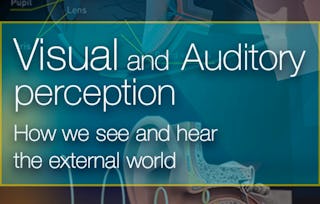
In this final module, we will continue discussing the senses focusing on vision and audition. At the end of the lesson, you will be able to describe the parts of the eye and parts of the retina. We will explain how receptor functions work, describe how to explain optical illusions, and go through aspects of depth perception. Finally, we will go into concepts surrounding hearing anatomy, transduction and adaptation. We will finish off this module with an optional podcast conversation with Dr. Armand Cardello.
Inclus
10 vidéos3 lectures1 devoir3 sujets de discussion
Afficher les informations sur le contenu du module
10 vidéos•Total 45 minutes
Module Introduction•1 minute
The Anatomy of the Eye•8 minutes
The Receptors•4 minutes
Visual Areas of the Brain•2 minutes
Optical Illusions•7 minutes
Depth Perception•3 minutes
Color Perception•7 minutes
Hearing: Audition•4 minutes
Hearing Transduction and Adaptation•7 minutes
Course Summary•2 minutes
3 lectures•Total 115 minutes
(Optional) Podcast: A Conversation with Dr. Armand Cardello•45 minutes
Chemesthesis: Pungency as a Component of Flavor•30 minutes
Sound Perception and Food Quality•40 minutes
1 devoir•Total 30 minutes
Module 4 Quiz•30 minutes
3 sujets de discussion•Total 30 minutes
(Optional Forum) Podcast: Dr. Armand Cardello•10 minutes
Influences on Sensory Evaluation Studies•10 minutes
Self-Reflection•10 minutes
Obtenez un certificat professionnel
Ajoutez ce titre à votre profil LinkedIn, à votre curriculum vitae ou à votre CV. Partagez-le sur les médias sociaux et dans votre évaluation des performances.
UC Davis, one of the nation’s top-ranked research universities, is a global leader in agriculture, veterinary medicine, sustainability, environmental and biological sciences, and technology. With four colleges and six professional schools, UC Davis and its students and alumni are known for their academic excellence, meaningful public service and profound international impact.
Pour quelles raisons les étudiants sur Coursera nous choisissent-ils pour leur carrière ?
Felipe M.
Étudiant(e) depuis 2018
’Pouvoir suivre des cours à mon rythme à été une expérience extraordinaire. Je peux apprendre chaque fois que mon emploi du temps me le permet et en fonction de mon humeur.’
Jennifer J.
Étudiant(e) depuis 2020
’J'ai directement appliqué les concepts et les compétences que j'ai appris de mes cours à un nouveau projet passionnant au travail.’
Larry W.
Étudiant(e) depuis 2021
’Lorsque j'ai besoin de cours sur des sujets que mon université ne propose pas, Coursera est l'un des meilleurs endroits où se rendre.’
Chaitanya A.
’Apprendre, ce n'est pas seulement s'améliorer dans son travail : c'est bien plus que cela. Coursera me permet d'apprendre sans limites.’
Avis des étudiants
4.9
14 avis
5 stars
85,71 %
4 stars
14,28 %
3 stars
0 %
2 stars
0 %
1 star
0 %
Affichage de 3 sur 14
N
NK
5·
Révisé le 11 févr. 2025
Very informative course to gain depth of Sensory knowledge.
When will I have access to the lectures and assignments?
To access the course materials, assignments and to earn a Certificate, you will need to purchase the Certificate experience when you enroll in a course. You can try a Free Trial instead, or apply for Financial Aid. The course may offer 'Full Course, No Certificate' instead. This option lets you see all course materials, submit required assessments, and get a final grade. This also means that you will not be able to purchase a Certificate experience.
What will I get if I subscribe to this Specialization?
When you enroll in the course, you get access to all of the courses in the Specialization, and you earn a certificate when you complete the work. Your electronic Certificate will be added to your Accomplishments page - from there, you can print your Certificate or add it to your LinkedIn profile.
Is financial aid available?
Yes. In select learning programs, you can apply for financial aid or a scholarship if you can’t afford the enrollment fee. If fin aid or scholarship is available for your learning program selection, you’ll find a link to apply on the description page.