Wenn Sie sich für diesen Kurs anmelden, werden Sie auch für diese Spezialisierung angemeldet.
Lernen Sie neue Konzepte von Branchenexperten
Gewinnen Sie ein Grundverständnis bestimmter Themen oder Tools
Erwerben Sie berufsrelevante Kompetenzen durch praktische Projekte
Erwerben Sie ein Berufszertifikat zur Vorlage
In diesem Kurs gibt es 4 Module
"Trees, SVM and Unsupervised Learning" is designed to provide working professionals with a solid foundation in support vector machines, neural networks, decision trees, and XG boost. Through in-depth instruction and practical hands-on experience, you will learn how to build powerful predictive models using these techniques and understand the advantages and disadvantages of each. The course will also cover how and when to apply them to different scenarios, including binary classification and K > 2 classes. Additionally, you will gain valuable experience in generating data representations through PCA and clustering. With a focus on practical, real-world applications, this course is a valuable asset for anyone looking to upskill or move into the field of data science.
This course can be taken for academic credit as part of CU Boulder’s Master of Science in Data Science (MS-DS) degree offered on the Coursera platform. The MS-DS is an interdisciplinary degree that brings together faculty from CU Boulder’s departments of Applied Mathematics, Computer Science, Information Science, and others. With performance-based admissions and no application process, the MS-DS is ideal for individuals with a broad range of undergraduate education and/or professional experience in computer science, information science, mathematics, and statistics. Learn more about the MS-DS program at https://hua.dididi.sbs/degrees/master-of-science-data-science-boulder.
The module provides an introductory overview of the course and introduces the course instructor.
Das ist alles enthalten
1 Video3 Lektüren1 Diskussionsthema
Infos zu Modulinhalt anzeigen
1 Video•Insgesamt 3 Minuten
Course 3 Introduction•3 Minuten
3 Lektüren•Insgesamt 21 Minuten
Course Updates and Accessibility Support•1 Minute
Earn Academic Credit for your Work!•10 Minuten
Course Support•10 Minuten
1 Diskussionsthema•Insgesamt 10 Minuten
Introduce Yourself!•10 Minuten
Support Vector Machines (SVMs)
Modul 2•4 Stunden abzuschließen
Moduldetails
To begin the course, we will learn about support vector machines (SVMs). SVMs have become a popular method in the field of statistical learning due to their ability to handle non-linear and high-dimensional data. SVMs seek to maximize the margin, or distance between the decision boundary and the closest data points, to improve generalization performance. Throughout the week, you will learn how to apply SVMs to classify or predict outcomes in a given dataset, select appropriate kernel functions and parameters, and evaluate model performance
Neural Networks have become increasingly popular in the field of statistical learning due to their ability to model complex relationships in data. In this module, we will cover introductory concepts of neural networks, such as activation functions and backpropagation. You will have the opportunity to apply Neural Networks to classify or predict outcomes in a given dataset and evaluate model performance in the labs for this module.
Das ist alles enthalten
5 Videos1 Lektüre1 Programmieraufgabe
Infos zu Modulinhalt anzeigen
5 Videos•Insgesamt 69 Minuten
Neural Networks: Part 1•24 Minuten
Neural Networks: Part 2•14 Minuten
Neural Networks: Part 3•14 Minuten
Neural Networks: Part 4•7 Minuten
Neural Networks And Its Application To Unsupervised Learning •10 Minuten
1 Lektüre•Insgesamt 90 Minuten
Neural Networks•90 Minuten
1 Programmieraufgabe•Insgesamt 90 Minuten
Neural Networks Lab and Assignment•90 Minuten
Decision Trees-Bagging-Random Forests
Modul 4•5 Stunden abzuschließen
Moduldetails
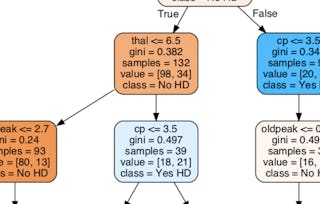
Welcome to the final module for the course. This module will focus on the ensemble methods decision trees, bagging, and random forests, which combine multiple models to improve prediction accuracy and reduce overfitting. Decision Trees are a popular machine learning method that partitions the feature space into smaller regions and models the response variable in each region using simple rules. However, Decision Trees can suffer from high variance and instability, which can be addressed by Bagging and Random Forests. Bagging involves generating multiple trees on bootstrapped samples of the data and averaging their predictions, while Random Forests further decorrelate the trees by randomly selecting subsets of features for each tree.
Fügen Sie dieses Zeugnis Ihrem LinkedIn-Profil, Lebenslauf oder CV hinzu. Teilen Sie sie in Social Media und in Ihrer Leistungsbeurteilung.
Auf einen Abschluss hinarbeiten
Dieses Kurs ist Teil des/der folgenden Studiengangs/Studiengänge, die von University of Colorado Boulderangeboten werden. Wenn Sie zugelassen werden und sich immatrikulieren, können Ihre abgeschlossenen Kurse auf Ihren Studienabschluss angerechnet werden und Ihre Fortschritte können mit Ihnen übertragen werden.¹
Mögliche Abschüsse anzeigen
Auf einen Abschluss hinarbeiten
Dieses Kurs ist Teil des/der folgenden Studiengangs/Studiengänge, die von University of Colorado Boulderangeboten werden. Wenn Sie zugelassen werden und sich immatrikulieren, können Ihre abgeschlossenen Kurse auf Ihren Studienabschluss angerechnet werden und Ihre Fortschritte können mit Ihnen übertragen werden.¹
¹Erfolgreiche Bewerbung und Einschreibung sind erforderlich. Es gelten die Zulassungsbedingungen. Jede Einrichtung legt die Anzahl der Credits fest, die durch die Absolvierung dieser Inhalte anerkannt werden und auf die Abschlussanforderungen angerechnet werden können, wobei bereits vorhandene Credits berücksichtigt werden. Klicken Sie auf einen bestimmten Kurs, um weitere Informationen zu erhalten.
CU Boulder is a dynamic community of scholars and learners on one of the most spectacular college campuses in the country. As one of 34 U.S. public institutions in the prestigious Association of American Universities (AAU), we have a proud tradition of academic excellence, with five Nobel laureates and more than 50 members of prestigious academic academies.
When will I have access to the lectures and assignments?
To access the course materials, assignments and to earn a Certificate, you will need to purchase the Certificate experience when you enroll in a course. You can try a Free Trial instead, or apply for Financial Aid. The course may offer 'Full Course, No Certificate' instead. This option lets you see all course materials, submit required assessments, and get a final grade. This also means that you will not be able to purchase a Certificate experience.
What will I get if I subscribe to this Specialization?
When you enroll in the course, you get access to all of the courses in the Specialization, and you earn a certificate when you complete the work. Your electronic Certificate will be added to your Accomplishments page - from there, you can print your Certificate or add it to your LinkedIn profile.
Is financial aid available?
Yes. In select learning programs, you can apply for financial aid or a scholarship if you can’t afford the enrollment fee. If fin aid or scholarship is available for your learning program selection, you’ll find a link to apply on the description page.