Wenn Sie sich für diesen Kurs anmelden, werden Sie auch für diese Spezialisierung angemeldet.
Lernen Sie neue Konzepte von Branchenexperten
Gewinnen Sie ein Grundverständnis bestimmter Themen oder Tools
Erwerben Sie berufsrelevante Kompetenzen durch praktische Projekte
Erwerben Sie ein Berufszertifikat zur Vorlage
In diesem Kurs gibt es 5 Module
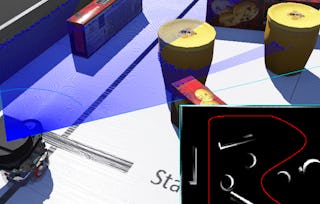
"Basic Robotic Behaviors and Odometry" provides you with an introduction to autonomous mobile robots, including forward kinematics (“odometry”), basic sensors and actuators, and simple reactive behavior. This course is centered around exercises in the realistic, physics-based simulator, “Webots”, where you will experiment in a hands-on manner with simple reactive behaviors for collision avoidance and line following, state machines, and basic forward kinematics of non-holonomic systems. An overarching objective of this course is to understand the role of the physical system on algorithm design and its role as source of uncertainty that makes robots non-deterministic. If you are interested in getting started with robotics, this course is for you!
This course can be taken for academic credit as part of CU Boulder’s MS in Computer Science degrees offered on the Coursera platform. These fully accredited graduate degrees offer targeted courses, short 8-week sessions, and pay-as-you-go tuition. Admission is based on performance in three preliminary courses, not academic history. CU degrees on Coursera are ideal for recent graduates or working professionals. Learn more:
MS in Computer Science: https://coursera.org/degrees/ms-computer-science-boulder
Welcome to Basic Robotic Behaviors and Odometry. This week introduces the course and gives you an opportunity to introduce yourself. You will prepare for the rest of the course by learning about the main operation tool we will use throughout, the realistic robotics simulator "Webots". You will become familiar with Webots, its hosting website, and will begin to develop your foundation in navigating the simulator.
Introduction to "Basic Robotic Behaviors and Odometry"•1 Minute
Video Lecture Week 1: Introduction•33 Minuten
What is a Robot?•4 Minuten
Building a World in Webots•11 Minuten
Webots - Collisions and Physics•4 Minuten
What Are Radians?•2 Minuten
More About Cyberbotics•4 Minuten
10 Lektüren•Insgesamt 256 Minuten
Course Updates and Accessibility Support•1 Minute
Earn Academic Credit for your Work!•10 Minuten
Course Support•10 Minuten
Assessment Expectations•10 Minuten
AI Citation and Acknowledgement•10 Minuten
Course Activities•5 Minuten
What is a Robot? •10 Minuten
The First Industrial Robot•10 Minuten
On the Road to Autonomous Cars•10 Minuten
Webots Tutorials 1-3•180 Minuten
3 Aufgaben•Insgesamt 45 Minuten
AI Policy Quiz•5 Minuten
What is a Robot? •10 Minuten
Hands-on: Controlling Motors Using Position or Velocity Control•30 Minuten
1 Diskussionsthema•Insgesamt 10 Minuten
Introduce Yourself!•10 Minuten
1 Plug-in•Insgesamt 45 Minuten
Webots User Guide •45 Minuten
Sensors and Actuators
Modul 2•6 Stunden abzuschließen
Moduldetails
This week introduces the devices that allow robots to move and effectuate changes in their environment ("actuators"), as well as perceive their world ("sensors").
Das ist alles enthalten
5 Videos9 Lektüren4 Aufgaben
Infos zu Modulinhalt anzeigen
5 Videos•Insgesamt 77 Minuten
Video Lecture Week 2: Sensors and Actuators•47 Minuten
Basic Actuators (Theory)•6 Minuten
Basic Actuators (Practice)•12 Minuten
Basic Sensors - Distance Sensors•10 Minuten
Basic Sensors - Light Sensors•2 Minuten
9 Lektüren•Insgesamt 180 Minuten
Actuators: Electric•20 Minuten
Other Types of Actuators•10 Minuten
Sensors•15 Minuten
Sensors That Measure: Joint Configuration•10 Minuten
Sensors That Measure: Ego-Motion•10 Minuten
Sensors That Measure: Force•10 Minuten
Sensors That Measure: Distance•10 Minuten
Global Positioning Systems•10 Minuten
Webots Tutorial 4-6•85 Minuten
4 Aufgaben•Insgesamt 93 Minuten
Actuators•15 Minuten
Sensors•18 Minuten
Hands-on: Exploring Light Sensors•30 Minuten
From Webots to Real Robotics•30 Minuten
Reactive Behaviors and State Machines
Modul 3•5 Stunden abzuschließen
Moduldetails
In this week, you will experiment with basic reactive robotic behaviors and understand the challenges of task execution.
Das ist alles enthalten
5 Videos1 Lektüre1 Aufgabe1 peer review
Infos zu Modulinhalt anzeigen
5 Videos•Insgesamt 45 Minuten
Video Lecture Week 3: Reactive Behaviors and State Machines•20 Minuten
Reactive Behavior - Collision Avoidance•7 Minuten
Reactive Behaviors - Compound Behaviors•5 Minuten
Finite State Machines•6 Minuten
Introduction to Peer Review "Basic Reactive Behaviors"•8 Minuten
1 Lektüre•Insgesamt 20 Minuten
Task Execution•20 Minuten
1 Aufgabe•Insgesamt 30 Minuten
Task Execution •30 Minuten
1 peer review•Insgesamt 180 Minuten
Basic Reactive Behaviors•180 Minuten
Coordinate Systems, Degrees of Freedom and Forward Kinematics
Modul 4•5 Stunden abzuschließen
Moduldetails
This week you will learn how to formally describe the global pose of a robot and how different actuators can affect this pose.
Das ist alles enthalten
7 Videos1 Lektüre3 Aufgaben
Infos zu Modulinhalt anzeigen
7 Videos•Insgesamt 70 Minuten
Video Lecture Week 4: Coordinate Systems, Degrees of Freedom, and Forward Kinematics•24 Minuten
Coordinate Systems and the Right Hand Rule(s)•10 Minuten
Degrees of Freedom•12 Minuten
Kinematics of Standard Wheels•7 Minuten
Rotation Matrices•4 Minuten
Setting Up the Line Following Course•7 Minuten
Hands-On Simple Odometry Overview•6 Minuten
1 Lektüre•Insgesamt 20 Minuten
Coordinate Systems and Degrees of Freedom •20 Minuten
3 Aufgaben•Insgesamt 240 Minuten
Coordinate Systems and Degrees of Freedom •30 Minuten
Hands-on: Simple Odometry•180 Minuten
Improving Odometry•30 Minuten
Localization with Odometry and Loop Closure
Modul 5•5 Stunden abzuschließen
Moduldetails
In this week, you will learn how to keep track of actuation commands and hence estimate the pose of your robot. You will use information from the environment to improve pose estimation and understand the concept of "holonomy".
Das ist alles enthalten
4 Videos2 Aufgaben1 peer review
Infos zu Modulinhalt anzeigen
4 Videos•Insgesamt 49 Minuten
Video Lecture Week 5: Coordinate Transforms and Odometry•25 Minuten
Coordinate Transforms•14 Minuten
Localization by Odometry and Loop Closure Overview•6 Minuten
Non-Holonomic Vehicle Example•5 Minuten
2 Aufgaben•Insgesamt 35 Minuten
Loop Closure•15 Minuten
Holonomy•20 Minuten
1 peer review•Insgesamt 240 Minuten
Robot Localization by Odometry and Loop Closure Overview•240 Minuten
Erwerben Sie ein Karrierezertifikat.
Fügen Sie dieses Zeugnis Ihrem LinkedIn-Profil, Lebenslauf oder CV hinzu. Teilen Sie sie in Social Media und in Ihrer Leistungsbeurteilung.
Auf einen Abschluss hinarbeiten
Dieses Kurs ist Teil des/der folgenden Studiengangs/Studiengänge, die von University of Colorado Boulderangeboten werden. Wenn Sie zugelassen werden und sich immatrikulieren, können Ihre abgeschlossenen Kurse auf Ihren Studienabschluss angerechnet werden und Ihre Fortschritte können mit Ihnen übertragen werden.¹
Mögliche Abschüsse anzeigen
Auf einen Abschluss hinarbeiten
Dieses Kurs ist Teil des/der folgenden Studiengangs/Studiengänge, die von University of Colorado Boulderangeboten werden. Wenn Sie zugelassen werden und sich immatrikulieren, können Ihre abgeschlossenen Kurse auf Ihren Studienabschluss angerechnet werden und Ihre Fortschritte können mit Ihnen übertragen werden.¹
¹Erfolgreiche Bewerbung und Einschreibung sind erforderlich. Es gelten die Zulassungsbedingungen. Jede Einrichtung legt die Anzahl der Credits fest, die durch die Absolvierung dieser Inhalte anerkannt werden und auf die Abschlussanforderungen angerechnet werden können, wobei bereits vorhandene Credits berücksichtigt werden. Klicken Sie auf einen bestimmten Kurs, um weitere Informationen zu erhalten.
OK
Dozent
Lehrkraftbewertungen
Wir haben alle Lernenden um Feedback zu unseren Dozenten gebeten, ausgehend von der Qualität ihres Unterrichtsstils.
CU Boulder is a dynamic community of scholars and learners on one of the most spectacular college campuses in the country. As one of 34 U.S. public institutions in the prestigious Association of American Universities (AAU), we have a proud tradition of academic excellence, with five Nobel laureates and more than 50 members of prestigious academic academies.
When will I have access to the lectures and assignments?
To access the course materials, assignments and to earn a Certificate, you will need to purchase the Certificate experience when you enroll in a course. You can try a Free Trial instead, or apply for Financial Aid. The course may offer 'Full Course, No Certificate' instead. This option lets you see all course materials, submit required assessments, and get a final grade. This also means that you will not be able to purchase a Certificate experience.
What will I get if I subscribe to this Specialization?
When you enroll in the course, you get access to all of the courses in the Specialization, and you earn a certificate when you complete the work. Your electronic Certificate will be added to your Accomplishments page - from there, you can print your Certificate or add it to your LinkedIn profile.
Is financial aid available?
Yes. In select learning programs, you can apply for financial aid or a scholarship if you can’t afford the enrollment fee. If fin aid or scholarship is available for your learning program selection, you’ll find a link to apply on the description page.