
You will develop reproducible analytics practices using R, paired with governance controls that make research outputs auditable and reliable for stakeholders. The course begins with file management and naming conventions, metadata tagging, and data-quality KPI monitoring to ensure high data integrity standards. It then introduces core R skills for data import, tidy transformations, and pipe-based workflows to join, filter, and aggregate multi-source datasets using the Tidyverse ecosystem. You will learn to author parameterized R Markdown reports to automate regular reporting and to perform diagnostic tests—such as cross-validation and resampling—to evaluate the robustness of regression and predictive modeling techniques commonly used in market research.

Market Research Data Analysis and Governance with R

Market Research Data Analysis and Governance with R
访问权限由 New York State Department of Labor 提供
您将学到什么
Apply R programming techniques for comprehensive data analysis and create automated, parameterized reports with R Markdown to minimize manual error.
Implement robust data governance and quality monitoring practices to ensure data integrity and auditability.
Evaluate and validate predictive models using advanced diagnostic techniques to improve accuracy and reliability.
Master data provenance to ensure findings are defensible and communicate insights effectively to stakeholders.
要了解的详细信息
了解顶级公司的员工如何掌握热门技能

积累 Data Analysis 领域的专业知识
- 向行业专家学习新概念
- 获得对主题或工具的基础理解
- 通过实践项目培养工作相关技能
- 通过 Coursera 获得可共享的职业证书

该课程共有9个模块
The Summarize and Evaluate Ethical AI Insights innovative module develops cutting-edge skills in AI-assisted qualitative analysis and ethical data practices. You will master techniques for using large language models to summarize qualitative data and critically evaluate the ethical implications of synthetic data. Through hands-on application, you will build advanced capabilities that combine AI tools with ethical considerations to enhance research insights.
涵盖的内容
4个视频3篇阅读材料4个作业
4个视频•总计28分钟
- What are AI-Powered Thematic Summaries?•7分钟
- A Tale of Two Prompts: Good vs. Bad Examples•8分钟
- The Double-Edged Sword of Synthetic Data•6分钟
- What to Look For: Identifying Bias and Privacy Leaks•7分钟
3篇阅读材料•总计20分钟
- Foundations of Prompt Engineering for Qualitative Insights•7分钟
- A Framework for Iterative Prompt Refinement•6分钟
- Understanding the Risks: Privacy, Bias, and Fidelity in Synthetic Data•7分钟
4个作业•总计85分钟
- Hands-On Learning: Your First AI-Augmented Summary•30分钟
- Knowledge Check: Principles of AI Summarization•5分钟
- Hands-On Learning: Drafting an Ethical Mitigation Plan•20分钟
- AI Ethics and Application Project•30分钟
Organize Research Data: File Management module provides a professional foundation for bringing order to digital chaos. You will navigate the essential stages of data processing—from raw collection to final analysis—while mastering standardized naming conventions and file structures. Through hands-on labs and real-world case studies, you'll develop the governance skills necessary to prevent costly errors and ensure long-term data integrity. By implementing these systematic approaches, you will transform disorganized files into accessible, high-value knowledge repositories. This experience empowers you to maintain reliable research systems that support accurate, data-driven decision-making.
涵盖的内容
4个视频4篇阅读材料5个作业
4个视频•总计20分钟
- The Reinhart-Rogoff Error: A Cautionary Tale•6分钟
- Spot the Difference: Identifying Data Stages in Clinical Trials•5分钟
- Walmart's Secret Weapon: Data Organization•4分钟
- Building Your Naming Convention: A Step-by-Step Guide•5分钟
4篇阅读材料•总计24分钟
- The Three Stages of Data: Raw, Cleaned, and Analyzed•5分钟
- Career Focus: The Data-Savvy Professional•5分钟
- The Unseen Engine of Efficiency: A Strategic Approach to File Naming•7分钟
- Career Focus: Your Data Organization Portfolio•7分钟
5个作业•总计65分钟
- Hands-On Learning: Data Sherlock: Classifying Sample Files•15分钟
- Knowledge Check: Data Stages Pop Quiz•5分钟
- Hands-On Learning: The Great File Rename•15分钟
- Knowledge Check: Data management Pop Quiz•5分钟
- The Research Rescue Project•25分钟
Govern and Evaluate Research Data Quality module builds data governance and quality management capabilities for research professionals. You will develop skills in applying metadata tagging for effective data governance and evaluating data quality against defined standards. Through practical application, you will build the technical capabilities needed to implement robust data management practices that ensure information integrity and accessibility.
涵盖的内容
4个视频3篇阅读材料3个作业
4个视频•总计27分钟
- What is Data Governance?•7分钟
- How to Apply Metadata Tags in a Simulated Environment?•6分钟
- When Good Data Goes Bad: A National Emergency•6分钟
- How to Create a Remediation Ticket in Jira?•8分钟
3篇阅读材料•总计19分钟
- Decoding Data Governance Policies•8分钟
- Understanding Data Quality Reports and KPIs•7分钟
- Anatomy of an Effective Remediation Ticket•4分钟
3个作业•总计55分钟
- Hands-On Learning: Tagging the Legacy Dataset•20分钟
- Knowledge Check: Interpreting Your Forecast•5分钟
- Data Governance and Quality Toolkit•30分钟
R: Code, Import, Transform Data is your professional entry point into the world of data analysis. Designed for aspiring analysts, this module teaches you to write R scripts that take full control of your datasets. You will progress from understanding core syntax—variables, vectors, and data frames—to importing CSVs and performing essential cleaning tasks. Through hands-on labs, you will master selecting data and renaming columns for maximum clarity. By the end, you'll have built a functional script that prepares raw data for analysis, a fundamental skill used by organizations like the BBC. This experience provides the critical building blocks for a successful data-driven career.
涵盖的内容
4个视频2篇阅读材料3个作业
4个视频•总计24分钟
- What Are Variables and Vectors?•7分钟
- How to Create Variables, Vectors, and Data Frames in R?•6分钟
- From Raw Data to Key Insights•6分钟
- From Import to Clean Data in R•5分钟
2篇阅读材料•总计22分钟
- Understanding R's Core Data Structure: The Data Frame•10分钟
- The Data Import and Transformation Workflow•12分钟
3个作业•总计50分钟
- Hands-On Learning: Your First R Objects•15分钟
- Knowledge Check: R Syntax Challenge•5分钟
- Write a Data-Cleaning R Script•30分钟
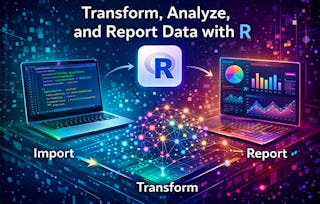
Transform, Analyze, and Report Data with R is your gateway to robust, scalable analysis. Designed for aspiring analysts, this module teaches you to build sophisticated end-to-end projects using the "Tidyverse" approach. You'll master dplyr to create clean, pipe-based workflows for filtering and merging complex data. You will also master automation—the hallmark of modern analysis—using R Markdown to generate dynamic reports. Finally, you'll evaluate predictive models using diagnostic tools like ROC curves. By the end, you'll have a portfolio-ready project and the skills to build efficient, reproducible workflows. No prior R experience is necessary.
涵盖的内容
6个视频3篇阅读材料6个作业
6个视频•总计32分钟
- Why Data Wrangling is the Heart of Analysis?•6分钟
- Mastering the dplyr Verbs•6分钟
- The Power of Push-Button Reporting•6分钟
- Introduction to knitr and Code Chunks•4分钟
- Why is a Single "Accuracy" Score Not Enough?•5分钟
- Evaluating a Classifier in R•6分钟
3篇阅读材料•总计32分钟
- A Guide to Data Wrangling: Tidy Principles and Table Joins•10分钟
- Guide to R Markdown: Anatomy and Career Value•10分钟
- Guide to Model Validation: Theory and Career Impact•12分钟
6个作业•总计85分钟
- Hands-On Learning: Create a Tidy Customer Dataset•15分钟
- Knowledge Check: dplyr and Data Pipeline•5分钟
- Hands-On Learning: Parameterize an Analytics Report•15分钟
- Knowledge Check: R Markdown and Parameterization Quiz•5分钟
- Hands-On Learning: Practice with Model Diagnostics•15分钟
- End-to-End Customer Churn Analysis and Report•30分钟
Excel for Data Analysis is a beginner-friendly guide to transforming raw numbers into compelling business stories. You will move beyond basic data entry to master essential statistical functions like AVERAGE, STDEV, and COUNTIF, enabling you to summarize complex datasets and uncover key metrics. Beyond calculations, you’ll learn the art of visual storytelling using conditional formatting to highlight trends and outliers. Through real-world scenarios—from sales tracking to NPS analysis—you will develop the skills to answer critical business questions. This experience culminates in a hands-on project, building a summary report that turns data into actionable insights.
涵盖的内容
6个视频3篇阅读材料4个作业
6个视频•总计35分钟
- Finding a Story in 1.1 Billion Taxi Rides•7分钟
- From Data to Decisions: Structured Analysis with the Core Four•6分钟
- Applying Functions to the Bellabeat Dataset•6分钟
- From Numbers to Narrative: Visualizing the Bellabeat Story•5分钟
- Understanding Conditional Formatting Rules•6分钟
- Step-by-Step: Highlighting Key Metrics in Bellabeat Data•6分钟
3篇阅读材料•总计25分钟
- Your Analytical Toolkit: Core Statistical Functions•10分钟
- Career Spotlight: Preventing Stockouts with Visual Alerts•7分钟
- Best Practices for Creating Clear Visual Reports•8分钟
4个作业•总计62分钟
- Hands-On Learning: Quick Insights from Taxi Data•13分钟
- Choosing Your Function: Inventory Scenario•5分钟
- Hands-On Learning: Highlighting Customer Feedback•14分钟
- Customer Satisfaction Analysis Report•30分钟
Statistical Tests for Market Research builds essential capabilities for extracting defensible insights from raw data. You will develop a strong understanding of statistical functionality while mastering hypothesis testing to compare group differences. This module moves beyond simply running tests to explaining why they matter for business strategy. Through hands-on applications like A/B testing and customer satisfaction analysis, you will master the two-sample t-test in Excel. You'll learn to interpret critical metrics like the p-value and translate them into actionable recommendations. These foundational skills empower you to use statistical evidence to validate assumptions and drive data-driven decision-making.
涵盖的内容
3个视频2篇阅读材料5个作业
3个视频•总计23分钟
- Your Analyst Toolkit: A Tour of Statistical Software•8分钟
- Hypothesis Testing Explained: The T-Test and P-Value•6分钟
- How-To: Run and Read a T-Test in Excel•9分钟
2篇阅读材料•总计16分钟
- From Business Questions to Statistical Answers with Excel•8分钟
- From Theory to Practice: T-Tests in a Professional Context•8分钟
5个作业•总计70分钟
- Hands-On Learning: Exploring Descriptive Statistics in Excel•15分钟
- Knowledge Check: Choosing Your Tools and Concepts•5分钟
- Hands-On Learning: Comparing Two Marketing Campaigns•15分钟
- Knowledge Check: Interpreting T-Test Results•5分钟
- Your First Statistical Testing Portfolio Piece•30分钟
Predict and Validate Regression Models in R is your professional entry point into the world of multiple linear regression. Designed for aspiring analysts, this module empowers you to build and interpret predictive models from the ground up. You will move beyond simply running code to critically evaluating performance through hands-on labs and real-world case studies. You will master diagnosing statistical assumptions using residual plots and assessing model reliability with k-fold cross-validation. By the end, you will build trustworthy models and generate dependable forecasts. This experience culminates in a validated, portfolio-ready project that supports strategic business decisions with confidence.
涵盖的内容
4个视频4篇阅读材料4个作业
4个视频•总计26分钟
- Beyond Accuracy: The Danger of a "Wrong" Model•7分钟
- Building and Diagnosing a Regression Model in R•7分钟
- The High-Stakes World of Clinical Trials•7分钟
- Implementing 10-Fold Cross-Validation in R•6分钟
4篇阅读材料•总计24分钟
- The Anatomy of a Multiple Regression Model•8分钟
- Connecting Your Skills to Your Career•3分钟
- Understanding K-Fold Cross-Validation•8分钟
- Your Future in Advanced Analytics•5分钟
4个作业•总计95分钟
- Hands-On Learning: Build and Diagnose a Predictive Regression Model•30分钟
- Knowledge Check: Interpreting Model Output and Diagnostics•5分钟
- Hands-On Learning: Validate Model Stability with K-Fold Cross-Validation•30分钟
- Predict and Validate Housing Prices•30分钟
Data Pipeline and Model Validation Lab is where you build a professional, reproducible R workflow. You will integrate data from multiple sources—CSVs, Excel, and JSON—while applying governance standards through automated metadata tagging and standardized cleaning. Using the tidyverse and dplyr, you'll develop pipe-based scripts to merge complex datasets and create parameterized R Markdown reports. The module culminates in building a multiple linear regression model, validated through 5-fold cross-validation and diagnostic plots. By the end, you will have a project demonstrating the technical and governance skills required for senior analytical roles.
涵盖的内容
2篇阅读材料1个作业
2篇阅读材料•总计6分钟
- Why This Project Matters•3分钟
- Project Requirements•3分钟
1个作业•总计110分钟
- Project: Reproducible Data Pipeline and Model Validation Lab•110分钟
获得职业证书
将此证书添加到您的 LinkedIn 个人资料、简历或履历中。在社交媒体和绩效考核中分享。
位教师

提供方

提供方

Coursera brings together a diverse network of subject matter experts who have demonstrated their expertise through professional industry experience or strong academic backgrounds. These instructors design and teach courses that make practical, career-relevant skills accessible to learners worldwide.
人们为什么选择 Coursera 来帮助自己实现职业发展

Felipe M.

Jennifer J.

Larry W.

Chaitanya A.
从 Data Science 浏览更多内容

课程
 C
CCoursera
课程
课程

¹ 本课程的部分作业采用 AI 评分。对于这些作业,将根据 Coursera 隐私声明使用您的数据。