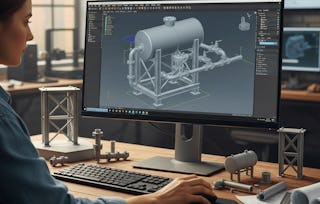
By the end of this course, learners will be able to model, refine, and assemble a complete multi-utility tool using SolidWorks part and assembly environments. Learners will apply parametric modeling principles, construct functional mechanical components, and validate assemblies through proper mating and motion control.

Design & Assemble a Multi-Utility Tool in SolidWorks

您将学到什么
Model functional mechanical parts in SolidWorks using parametric features and clear design intent.
Assemble multi-component tools using proper mates, motion control, and validation techniques.
Apply professional CAD workflows to plan, edit, and optimize models for real-world design changes.
您将获得的技能
要了解的详细信息

可分享的证书
添加到您的领英档案
作业
16 项作业
授课语言:英语(English)
最近已更新!
February 2026
了解顶级公司的员工如何掌握热门技能

积累特定领域的专业知识
本课程是 Design & Assemble Mechanical Systems in SolidWorks 专项课程 专项课程的一部分
在注册此课程时,您还会同时注册此专项课程。
- 向行业专家学习新概念
- 获得对主题或工具的基础理解
- 通过实践项目培养工作相关技能
- 获得可共享的职业证书


人们为什么选择 Coursera 来帮助自己实现职业发展

Felipe M.
自 2018开始学习的学生
''能够按照自己的速度和节奏学习课程是一次很棒的经历。只要符合自己的时间表和心情,我就可以学习。'

Jennifer J.
自 2020开始学习的学生
''我直接将从课程中学到的概念和技能应用到一个令人兴奋的新工作项目中。'

Larry W.
自 2021开始学习的学生
''如果我的大学不提供我需要的主题课程,Coursera 便是最好的去处之一。'

Chaitanya A.
''学习不仅仅是在工作中做的更好:它远不止于此。Coursera 让我无限制地学习。'
学生评论
- 5 stars
91.66%
- 4 stars
8.33%
- 3 stars
0%
- 2 stars
0%
- 1 star
0%
显示 3/12 个
RB
已于 May 12, 2026审阅
Engaging from start to finish. Designing the various blades and tools required a mix of creative thinking and technical precision that made the entire SolidWorks learning process feel like play.
VR
已于 May 26, 2026审阅
Perfect for engineers wanting to sharpen their design logic. Building the multi-utility tool taught me crucial lessons about tolerances and moving part interference.
RP
已于 May 18, 2026审阅
It covers the nuances of bookkeeping for financial reporting in a way that is both academically rigorous and professionally relevant.
从 Computer Science 浏览更多内容
Dassault Systèmes
Dassault Systèmes