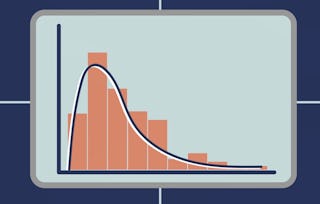
Welcome to Bayesian Statistical Concepts and Methods. In this course, you will use Bayesian methods in data analysis and modeling; work with posterior distributions, distributions without closed form, directed acyclic graphs, Markov Chain Monte Carlo algorithms; and employ R and the Stan platform for statistical modeling. You will also be introduced to Bayesian hierarchical models, which are useful for the interpretation of multi-level data (sub-group versus group).

您将学到什么
Participants will learn fundamentals of Bayesian concepts and methods, including Bayesian models, Bayesian networks, and Markov chain Monte Carlo.
您将获得的技能
要了解的详细信息

添加到您的领英档案
3 项作业
January 2026
了解顶级公司的员工如何掌握热门技能

积累特定领域的专业知识
- 向行业专家学习新概念
- 获得对主题或工具的基础理解
- 通过实践项目培养工作相关技能
- 获得可共享的职业证书

该课程共有3个模块
This Specialization covers the use of statistical methods in today's business, industrial, and social environments, including several new methods and applications. H.G. Wells foresaw an era when the understanding of basic statistics would be as important for citizenship as the ability to read and write. Modern Statistics for Data-Driven Decision-Making teaches the basics of working with and interpreting data, skills necessary to succeed in Wells’s “new great complex world” that we now inhabit. In this course, learners will be able to use Bayesian methods in data analysis and modeling, to work with posterior distributions, distributions without closed form, directed acyclic graphs, and Markov chain Monte Carlo algorithms, and to use R and the Stan platform for statistical modeling. Learn more about the instructors who developed this course. Read the instructor bios and review the learning outcomes for the course.
涵盖的内容
5个视频3篇阅读材料1个作业
In Module 2, we will draw a Bayesian model as a graph and distinguish posterior distribution, posterior predictive distribution, and expected loss or cost. We will also calculate distributions without closed form, recognizing that we can use computational methods to draw from the distribution even when there's no straight-forward equation to define them. Be sure to review the learning objectives before beginning work in this module.
涵盖的内容
9个视频2篇阅读材料1个作业
In Module 3, we will employ R and the Stan platform for statistical modeling. You will explore Bayesian methods in data analysis and modeling; work with posterior distributions, distributions without closed form, directed acyclic graphs, and Markov Chain Monte Carlo algorithms. You will also be introduced to Bayesian hierarchical models, which estimate subgroup parameters relative to the parameters of a larger parent group. Be sure to view the course introduction video and review the learning objectives before beginning work in this module.
涵盖的内容
10个视频3篇阅读材料1个作业1次同伴评审
获得职业证书
将此证书添加到您的 LinkedIn 个人资料、简历或履历中。在社交媒体和绩效考核中分享。
人们为什么选择 Coursera 来帮助自己实现职业发展

Felipe M.

Jennifer J.

Larry W.

Chaitanya A.
从 Data Science 浏览更多内容

University of California, Santa Cruz
University of California, Santa Cruz
Duke University

Illinois Tech