
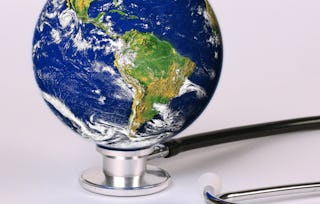
This fifth and final course is centered on planetary health as a fundamental health determinant. As we consider how the health of humans is dependent on the health of Earth’s natural systems, we will also explore how to apply futures thinking and foresight principles to planetary health initiatives. The topics of this course include:

Social Determinants of Health: Planetary Health

Social Determinants of Health: Planetary Health
访问权限由 New York State Department of Labor 提供
您将获得的技能
- Data Analysis
- Regression Analysis
- Sustainable Development
- Health Education
- Community Health
- Data Visualization
- Environmental Science
- Health Informatics
- Environmental Monitoring
- Systems Thinking
- Health Policy
- Scatter Plots
- Health Equity
- Public Health
- Forecasting
- Climate Change Adaptation
- Social Determinants Of Health
- 技能部分已折叠。显示 9 项技能,共 17 项。
要了解的详细信息
了解顶级公司的员工如何掌握热门技能

积累特定领域的专业知识
本课程是 Social Determinants of Health: Data to Action 专项课程 专项课程的一部分
在注册此课程时,您还会同时注册此专项课程。
- 向行业专家学习新概念
- 获得对主题或工具的基础理解
- 通过实践项目培养工作相关技能
- 获得可共享的职业证书

该课程共有5个模块
The field of planetary health is based on the idea that the health of humans is dependent on the health of Earth’s natural systems. This module introduces the concept of planetary health and explains how it can be used as a framework for understanding other social determinants of health. The first lesson provides an overview of planetary health as a discipline, paradigm and movement. Lesson two explores the Indigenous origins of planetary health, and how the Great Acceleration has rapidly increased anthropogenic changes to the environment. Finally, in lesson three, we examine how planetary health addresses environmental determinants of health.
涵盖的内容
4个视频6篇阅读材料2个作业1个讨论话题1个插件
Module 2 builds on what you learned in the previous module, as we take a more in depth look at planetary boundaries and the key data supporting our current understanding of planetary health. Climate change is not the only issue we are facing, and in lesson two, we investigate the broad range of environmental issues caused by humans and the resulting human health impacts of these disruptions. In lesson three, we take a look at the 12 cross-cutting principles of planetary health education which define the guiding themes and values of the emerging field. These principles provide a foundation for the growing interest and efforts in the field. We wrap up this module by looking at sources of planetary health knowledge, as we begin to reflect on how we can all take action in improving planetary health.
涵盖的内容
5个视频4篇阅读材料2个作业1个讨论话题1个插件
In this module, we will explore movement building and emerging evidence-based planetary health solutions as we discuss how to combat the complex environmental issues covered in previous modules. Lesson one introduces the idea of The Great Transition, which will require innovation across fields and collaboration across social sectors to address planetary health concerns. We will also review organizations focused on evidence-based climate change solutions. In lesson two, we will analyze strategies for organizing an effective movement to enact widespread planetary health initiatives that will create change on a global scale. While the issue of planetary health can seem overwhelming, lesson three offers reasons to be hopeful for the future, as we consider the changes we can make in our own life to address planetary health issues.
涵盖的内容
5个视频5篇阅读材料2个作业1个讨论话题2个插件
The purpose of this module is to introduce the concept of futures literacy and foresight leadership as people tackle the challenges of planetary health initiatives. People who want to bridge innovations across contexts must become time-conscious, future literate and embrace the dynamics of appreciation, influence and agency as they navigate change and transformation efforts. The development of futures literacy involves attention to the development and cultivation of futures thinking and foresight leadership. In part one, foresight is defined and several types of foresight leadership styles are described. In part two, strategies to develop foresight leadership are described and people are invited to apply futures thinking and foresight principles and practices to planetary health initiatives.
涵盖的内容
2个视频4篇阅读材料2个作业1个讨论话题2个插件
This module will focus on analyzing, displaying and interpreting social determinants of health data, with a particular focus on predicting health outcomes based on various social determinants of health and environmental variables. Lesson one will provide an overview of regression analysis and scatter plot visualization. In lesson two, we will learn how to conduct regression analyses and create scatter plots in R. Using the NHANES dataset, we will predict general health status based on age, BIPOC, marital status, education, household size, income, insurance, BMI, depression, smoker, and drinks/day. Using the Omaha System dataset, we will predict final status score based on baseline status score, BIPOC, marstat and social determinant of health variables. Finally, we will discuss how to interpret the results of our analysis as we visualize our findings using line graphs and scatter plots.
涵盖的内容
2个视频4篇阅读材料1次同伴评审1个讨论话题1个非评分实验室2个插件
获得职业证书
将此证书添加到您的 LinkedIn 个人资料、简历或履历中。在社交媒体和绩效考核中分享。
位教师


人们为什么选择 Coursera 来帮助自己实现职业发展

Felipe M.
自 2018开始学习的学生
''能够按照自己的速度和节奏学习课程是一次很棒的经历。只要符合自己的时间表和心情,我就可以学习。'

Jennifer J.
自 2020开始学习的学生
''我直接将从课程中学到的概念和技能应用到一个令人兴奋的新工作项目中。'

Larry W.
自 2021开始学习的学生
''如果我的大学不提供我需要的主题课程,Coursera 便是最好的去处之一。'

Chaitanya A.
''学习不仅仅是在工作中做的更好:它远不止于此。Coursera 让我无限制地学习。'
从 Health 浏览更多内容

University of Michigan

Yale University
University of Michigan

University of Michigan
¹ 本课程的部分作业采用 AI 评分。对于这些作业,将根据 Coursera 隐私声明使用您的数据。