
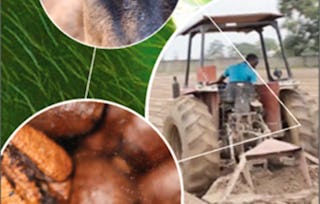
This course focuses on the Food-Energy-Water (FEW) nexus as an example of integrated systems thinking in science that can resolve resource gaps and help communities plan for the future. Through a series of four modules, learners will view lectures on the nexus approach, the challenges of climate change to FEW resources, specific challenges and programs from four global locations, and a survey of diverse technologies and solutions that are essential to providing enough food, energy, and water for current and future generations.

Our Global FEWture: Cultivating Food-Energy-Water Solutions

Our Global FEWture: Cultivating Food-Energy-Water Solutions

位教师:Heidi Scott
访问权限由 New York State Department of Labor 提供
要了解的详细信息
了解顶级公司的员工如何掌握热门技能

该课程共有4个模块
This course is all about understanding the ways we can develop efficient and integrated methods for providing three essential resources: food, energy, and water. Considering forecasted increases in population, the need to build a better quality of life in developing countries, and the challenges posed by climate change, this course on FEW systems is a timely, essential inquiry into the science and technology of building community resilience. In this introductory module, UMD Public Health scientists detail the systems thinking behind the food-energy-water nexus. After a historical overview of how past societies have approached water distribution for irrigation, and details of how these resources are interdependent, the lecturers turn to our present challenges and opportunities with FEW resource provision amid ongoing and intensifying climate change.
涵盖的内容
8个视频3个作业1个讨论话题
This second module deepens our inquiry into how climate change is already challenging agriculture and public health in the developing world, with specific views of agriculture in sub-Saharan Africa, and how snow pack and glacial melt provide essential freshwater for Himalayan and downstream communities. In each case, lecturers provide views of how systems thinking in the FEW nexus helps planning for resources as their supply becomes less predictable.
涵盖的内容
4个视频2个作业
Our third module turns to FEW nexus solutions already at work in four different global locations: Tanzania, Israel, Nepal, and the USA. Our lecturers detail the climate-related challenges in each location. They discuss ways that universities and nonprofits can work together with communities to build FEW capacity and develop education programs that train the next generation of farmers, water managers, and renewable energy experts.
涵盖的内容
5个视频2个作业
Our final module is a detailed exploration of FEW nexus technologies and solutions of today and tomorrow. Each lecturer considers the FEW nexus as a system, where a closed loop allows the most efficient use of waste products to support more resilient foundations for providing clean water, nutritious food, and renewable energy while advancing communities' self-determination.
涵盖的内容
8个视频1篇阅读材料3个作业1个讨论话题
位教师


人们为什么选择 Coursera 来帮助自己实现职业发展

Felipe M.
自 2018开始学习的学生
''能够按照自己的速度和节奏学习课程是一次很棒的经历。只要符合自己的时间表和心情,我就可以学习。'

Jennifer J.
自 2020开始学习的学生
''我直接将从课程中学到的概念和技能应用到一个令人兴奋的新工作项目中。'

Larry W.
自 2021开始学习的学生
''如果我的大学不提供我需要的主题课程,Coursera 便是最好的去处之一。'

Chaitanya A.
''学习不仅仅是在工作中做的更好:它远不止于此。Coursera 让我无限制地学习。'
从 Physical Science and Engineering 浏览更多内容
University of Copenhagen
Universitat Autònoma de Barcelona

Banco Interamericano de Desarrollo
University of Illinois Urbana-Champaign
¹ 本课程的部分作业采用 AI 评分。对于这些作业,将根据 Coursera 隐私声明使用您的数据。