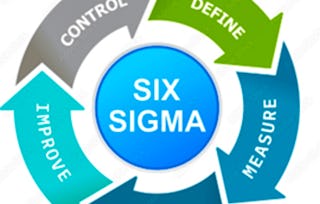
This course is designed to guide you on how to prepare for the American Society for Quality Certified Six Sigma Black Belt (ASQ CSSBB) certification, a mark of quality excellence across industries.

您将学到什么
Identify the statistical analysis tools required for quality and process improvement in each phase of the DMAIC methodology.
Describe the statistical processes of each phase of the DMAIC methodology used for operational efficiency.
Apply statistical analysis tools for representing relationships, analyzing systems, and testing hypotheses.
Implement design experiments and apply statistical process control to streamline business processes.
您将获得的技能
- Kaizen Methodology
- Statistical Hypothesis Testing
- Business Process
- Quality Improvement
- Process Capability
- Process Analysis
- Six Sigma Methodology
- Sample Size Determination
- Process Improvement
- Risk Analysis
- Data Collection
- Statistical Methods
- Risk Management
- Lean Methodologies
- Statistical Analysis
- Statistical Process Controls
- 技能部分已折叠。显示 8 项技能,共 16 项。
要了解的详细信息
了解顶级公司的员工如何掌握热门技能

积累特定领域的专业知识
- 向行业专家学习新概念
- 获得对主题或工具的基础理解
- 通过实践项目培养工作相关技能
- 获得可共享的职业证书

该课程共有4个模块
In this module, you will learn about the various statistical tools you can use for process analysis and data collection. The module delves into the statistical technique of measurement system analysis (MSA). You will also learn how to use graphical tools to construct and interpret diagrams and charts. You will be equipped with how the results of statistical studies are used to draw valid conclusions, the distribution methods relevant to probability, and the techniques used for process capability. Finally, you will learn to interpret the difference between short-term and long-term capabilities.
涵盖的内容
8个视频2篇阅读材料3个作业1个讨论话题
In this module, you will learn how to measure and model relationships between variables. You will explore the correlation coefficient, linear regression, and multivariate tools. The module also delves into applying the key concepts of hypothesis testing, such as the significance of testing, calculating sample size, and analyzing waste. You will become acquainted with techniques such as point and interval estimates and tests for means, variances, and proportions. Additionally, you will learn the analysis of variance (ANOVA) and goodness-of-fit (chi-square) tests and the techniques for analyzing and managing risk.
涵盖的内容
7个视频1篇阅读材料3个作业1个讨论话题
In this module, you will explore the key concepts of the design of experiments (DOE). You will also learn how to apply the principles of DOE, such as power, sample size, balance, repetition, replication, order, efficiency, randomization, blocking, interaction, confounding, and resolution. The module will take you through planning and evaluating different types of experiments in DOE and various types of Lean methods you can use for process improvement, like waste elimination, cycle-time reduction, Kaizen, and others. Additionally, the module focuses on statistical process control (SPC) and other controls that help to streamline business processes. Finally, you will learn how to sustain process improvements using methods like documentation, training, and evaluation.
涵盖的内容
5个视频1篇阅读材料2个作业1个讨论话题
This is a peer-review assignment based on the concepts taught in the Advanced Statistical Analysis and Tools course. In this assignment, you have been provided with a real-life scenario. You must explain how you can use process capabilities and their related metrics in process improvement.
涵盖的内容
1个视频2篇阅读材料1次同伴评审
获得职业证书
将此证书添加到您的 LinkedIn 个人资料、简历或履历中。在社交媒体和绩效考核中分享。
人们为什么选择 Coursera 来帮助自己实现职业发展

Felipe M.

Jennifer J.

Larry W.

Chaitanya A.
学生评论
- 5 stars
100%
- 4 stars
0%
- 3 stars
0%
- 2 stars
0%
- 1 star
0%
显示 3/10 个
已于 Oct 10, 2025审阅
Excellent effort, Your analysis of Process Capability is very understandable. A small improvement: consider expanding on the key steps to make it stronger. Well done.
已于 Mar 31, 2024审阅
The course provides very good clarity on the complex concepts.
从 Data Science 浏览更多内容

Kennesaw State University
¹ 本课程的部分作业采用 AI 评分。对于这些作业,将根据 Coursera 隐私声明使用您的数据。