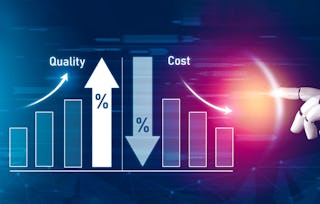
This comprehensive course is for product managers, ML engineers, and technical leads responsible for transforming LLM concepts into reliable, cost-effective production services. In today's AI-driven landscape, building a functional model is only the beginning. You will learn the complete framework for measuring, documenting, and optimizing LLM applications to ensure that they deliver real business value efficiently and consistently.
抓住节省的机会!购买 Coursera Plus 3 个月课程可享受40% 的折扣,并可完全访问数千门课程。

Evaluating LLM Performance and Efficiency

包含在 中
您将学到什么
Create PRDs with requirements and success metrics, and evaluate features against user-story acceptance criteria to identify gaps.
Evaluate prompt patterns and compute-spend reports to implement model-optimization techniques that reduce operational costs.
Analyze pipelines using value-stream mapping to eliminate inefficiencies and prioritize chatbot KPI optimizations.
Create technical documentation for vector index updates and evaluate system effectiveness against business requirements.
您将获得的技能
- Prompt Patterns
- Cost Reduction
- Operational Efficiency
- MLOps (Machine Learning Operations)
- Product Requirements
- Process Optimization
- Workflow Management
- Cost Management
- Standard Operating Procedure
- Artificial Intelligence and Machine Learning (AI/ML)
- LLM Application
- Process Mapping
- Large Language Modeling
- Key Performance Indicators (KPIs)
- User Acceptance Testing (UAT)
- Model Evaluation
要了解的详细信息
了解顶级公司的员工如何掌握热门技能

积累特定领域的专业知识
- 向行业专家学习新概念
- 获得对主题或工具的基础理解
- 通过实践项目培养工作相关技能
- 获得可共享的职业证书

该课程共有4个模块
This module teaches how to prevent LLM failures—like "hallucinated" advice—through professional product management. You will learn to draft a Product Requirements Document (PRD) as a single source of truth for scope, MVP features, and success metrics. The curriculum transitions from planning to validation, covering User Acceptance Testing (UAT) based on testable user stories. Through hands-on activities, you’ll draft a PRD for an HR chatbot and test for dangerous edge cases. By the end, you’ll be equipped to deliver safe, effective AI features that align with your business vision.
涵盖的内容
4个视频2篇阅读材料3个作业1个非评分实验室
This module provides ML engineers and practitioners with the operational discipline needed to transition LLM prototypes into reliable production services. You will move from "prompt artistry" to prompt science, learning to systematically evaluate and A/B test prompt patterns while balancing response quality, consistency, and token costs. The curriculum focuses on creating professional-grade operational documentation, such as step-by-step run-books for vector index updates, complete with validation checks and rollback procedures. By developing an LLMOps Production-Readiness Toolkit, you will gain the expertise to make data-driven decisions that ensure both high performance and cost efficiency in live AI systems.
涵盖的内容
3个视频3篇阅读材料3个作业
This module bridges technical execution and operational excellence for ML practitioners. You will master two critical pillars: cost optimization and process streamlining. First, you’ll dive into MLOps financials, learning to dissect compute-spend reports and implement technical optimizations like INT8 quantization to reduce overhead. Next, you will apply Value-Stream Mapping (VSM) to ML pipelines using tools like Miro to visualize workflows and eliminate manual bottlenecks. By the end, you’ll be equipped to design automated, future-state processes that ensure your LLM deployments are fast, cost-efficient, and business-aligned.
涵盖的内容
4个视频2篇阅读材料4个作业
Step into the role of a senior analyst tasked with overhauling an underperforming and costly LLM chatbot. In this module, you will conduct a comprehensive 360-degree audit to diagnose core issues across product, performance, and process. You’ll define KPIs, perform a feature gap-analysis, run experiments to optimize prompt strategies, and use value-stream mapping and cost modeling to identify savings and efficiencies, delivering actionable recommendations to improve performance, reduce costs, and create a high-value asset for your portfolio.
涵盖的内容
2篇阅读材料1个作业
获得职业证书
将此证书添加到您的 LinkedIn 个人资料、简历或履历中。在社交媒体和绩效考核中分享。
位教师

提供方
从 Machine Learning 浏览更多内容
状态:免费试用
状态:免费试用
状态:免费试用Simplilearn
状态:免费试用
人们为什么选择 Coursera 来帮助自己实现职业发展

Felipe M.

Jennifer J.

Larry W.

Chaitanya A.
常见问题
Yes. The course balances product and technical topics. Product managers will gain practical tools—PRD templates, acceptance checks, and KPI analysis—while labs and examples explain technical concepts at an applied level. Technical partners may help with any hands-on compute analysis.
You will compare common patterns such as Zero-Shot, Few-Shot, and Chain-of-Thought using controlled benchmarking workflows. Labs guide you through setting up experiments, measuring KPI changes, and documenting the strategies that work best for specific tasks.
Yes. The course covers analyzing compute–spend reports and proposes practical optimizations—model selection, quantization strategies, and pipeline improvements identified via value-stream mapping—so that you can recommend prioritized, actionable cost reductions.
更多问题
提供助学金,
¹ 本课程的部分作业采用 AI 评分。对于这些作业,将根据 Coursera 隐私声明使用您的数据。