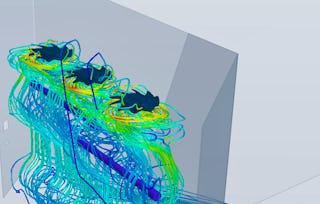
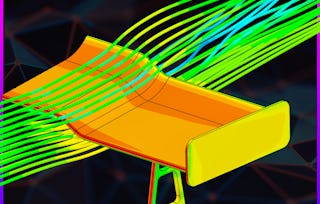
Engineers today are expected to evaluate designs before prototypes are built—this is where CFD becomes indispensable. This intermediate-level course empowers learners to simulate fluid behavior using ANSYS Fluent and apply it to real-world problems across thermal and aerodynamic systems. The course begins with a conceptual foundation in CFD solvers and governing equations, then transitions to project-based learning through structured videos, scenario-driven coach dialogues, and hands-on labs. Learners will practice the full simulation workflow—from geometry creation and meshing to physics setup and post-processing.

您将学到什么
Explain and apply fundamental CFD principles including governing equations, turbulence models, solver strategies used in ANSYS Fluent
Setup and execute Simulation for Low speed and High speed applications, including geometry creation, meshing, numerical setup, and post-processing
Analyze and interpret CFD results—flow behavior, drag forces, thermal effects, and shock structures—and propose design improvements based on insights
您将获得的技能
要了解的详细信息

添加到您的领英档案
February 2026
1 项作业
了解顶级公司的员工如何掌握热门技能

该课程共有3个模块
This module introduces the fundamentals of Computational Fluid Dynamics, including governing equations, types of solvers, and how a CFD tool like ANSYS Fluent computes flow solutions. It provides the essential foundation needed before moving into the applied modules, where learners will work with Fluent on real-world examples. By completing this module, learners will develop a solid conceptual understanding of CFD rather than jumping straight into software operation.
涵盖的内容
4个视频2篇阅读材料1次同伴评审
This module will walk through the Numerical Simulation of Interior Environment by utilising the pressure based solver (generally used for low speed aerodynamic simulations).Through this Simulation, the learner will understand the workflow of ANSYS Fluent, understand the modelling techniques of a low-speed aerodynamic simulation. The learner will gain working knowledge of the tool, by creating the domain, discretisation of the domain, setting up the physics, and post processing the simulation results. Completing this module will add expertise to tackle any low speed aerodynamic flow field.
涵盖的内容
3个视频1篇阅读材料1次同伴评审
This module will walk through the usgae of next type of flow solver in ANSYS Fluent i.e., density based flow solver typically used for high speed aerodynamic simulations. Leaners will be demonstrated with a case i.e., to numerically simulate the flow field of a blunt body (missile/re-entry body) crusing at Supersonic Speed. The learner will get acquanted with the numerical scheme required for this kind of simulation, what will be the consideration and methods to built the model and run a precise simulation. It should give an hands on experience to tackle similar simulations in their career.
涵盖的内容
4个视频1篇阅读材料1个作业2次同伴评审
提供方
从 Security 浏览更多内容
状态:预览
状态:预览
状态:预览
人们为什么选择 Coursera 来帮助自己实现职业发展

Felipe M.

Jennifer J.

Larry W.

Chaitanya A.
常见问题
To access the course materials, assignments and to earn a Certificate, you will need to purchase the Certificate experience when you enroll in a course. You can try a Free Trial instead, or apply for Financial Aid. The course may offer 'Full Course, No Certificate' instead. This option lets you see all course materials, submit required assessments, and get a final grade. This also means that you will not be able to purchase a Certificate experience.
When you purchase a Certificate you get access to all course materials, including graded assignments. Upon completing the course, your electronic Certificate will be added to your Accomplishments page - from there, you can print your Certificate or add it to your LinkedIn profile.
Yes. In select learning programs, you can apply for financial aid or a scholarship if you can’t afford the enrollment fee. If fin aid or scholarship is available for your learning program selection, you’ll find a link to apply on the description page.
更多问题
提供助学金,