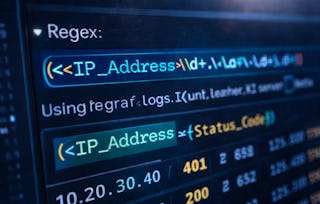
By the end of this course, learners will be able to configure Windows and agentless inputs, ingest data using multiple Splunk methods, parse and normalize events accurately, manage timestamps and time zones, and classify data effectively for reliable analysis.
您将学到什么
Configure Windows and agentless Splunk inputs to ingest data using multiple collection methods.
Parse, normalize, and classify Windows event data with accurate timestamps and metadata.
Design and troubleshoot end-to-end Splunk data onboarding workflows for reliable analysis.
您将获得的技能
要了解的详细信息

添加到您的领英档案
February 2026
12 项作业
了解顶级公司的员工如何掌握热门技能

该课程共有3个模块
This module introduces the fundamentals of collecting Windows data in Splunk. Learners explore Windows-specific input types, agent-based and agentless data collection approaches, and configuration best practices. The module emphasizes selecting appropriate inputs, understanding app context and configuration scope, and collecting critical operational and security data using Event Logs, performance monitoring, and PowerShell inputs. By the end of this module, learners will be prepared to design reliable and maintainable Windows data ingestion strategies in Splunk environments.
涵盖的内容
8个视频4个作业
This module focuses on advanced data ingestion techniques and configuration controls in Splunk. Learners examine agentless inputs, HTTP Event Collector (HEC), metadata specification, and input fine-tuning for efficiency and accuracy. The module also introduces parsing fundamentals through monitor inputs and the data preview process, enabling learners to validate and optimize data onboarding before indexing. This module builds the skills required to ingest diverse data sources reliably in enterprise environments.
涵盖的内容
8个视频4个作业
This module covers the critical aspects of parsing, timestamp management, and data classification in Splunk. Learners focus on defining event boundaries, handling single-line and multi-line events, configuring time zones, and extracting accurate timestamps. The module also emphasizes data validation and classification using metadata fields such as source, sourcetype, and host. By completing this module, learners gain the ability to ensure data accuracy and consistency for reliable searching, reporting, and analytics.
涵盖的内容
9个视频4个作业
从 Support and Operations 浏览更多内容
人们为什么选择 Coursera 来帮助自己实现职业发展

Felipe M.

Jennifer J.

Larry W.

Chaitanya A.
常见问题
To access the course materials, assignments and to earn a Certificate, you will need to purchase the Certificate experience when you enroll in a course. You can try a Free Trial instead, or apply for Financial Aid. The course may offer 'Full Course, No Certificate' instead. This option lets you see all course materials, submit required assessments, and get a final grade. This also means that you will not be able to purchase a Certificate experience.
When you enroll in the course, you get access to all of the courses in the Specialization, and you earn a certificate when you complete the work. Your electronic Certificate will be added to your Accomplishments page - from there, you can print your Certificate or add it to your LinkedIn profile.
Yes. In select learning programs, you can apply for financial aid or a scholarship if you can’t afford the enrollment fee. If fin aid or scholarship is available for your learning program selection, you’ll find a link to apply on the description page.
更多问题
提供助学金,