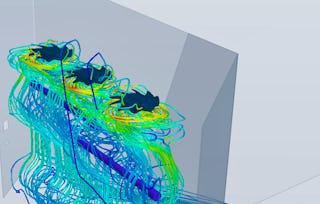
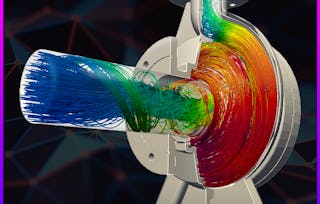
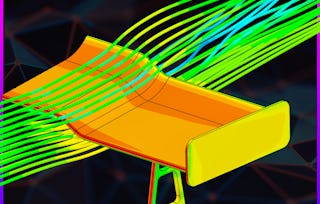
Learn to perform CFD simulations using STAR-CCM+ through a clear, application-focused introduction to the full simulation workflow. This course teaches you how to prepare a fluid airfoil geometry, define the surrounding fluid domains, and generate high-quality meshes that will solve the governing fluid dynamic equations. You will set up physics models for fluid flow and heat transfer, apply appropriate boundary conditions, and control solver settings for steady and transient simulations. Along the way, you’ll explore mesh refinement strategies, turbulence modeling, convergence monitoring, and common troubleshooting methods. Hands-on exercises guide you in visualizing results with velocity and pressure contours, plots, and force reports to extract meaningful engineering insights.
This course is designed for engineering students, CFD practitioners, and mechanical, marine, or aerospace engineers who want hands-on experience setting up, running, and analyzing fluid flow and thermal simulations using STAR-CCM+.
Learners should have a basic understanding of fluid dynamics, integral and differential calculus, and numerical methods used to solve the Navier–Stokes equations.
By the end of the course, you will be able to confidently build, run, and analyze complete CFD simulations in STAR-CCM+ and apply these skills to real engineering applications.
Introduction to the STAR-CCM+ CFD workflow with a focus on preparing external-flow geometries and generating high-quality meshes for marine and industrial fluid simulations. Learners build the foundational skills required to discretize fluid domains accurately, resolve boundary layers, and establish numerically stable CFD models that support reliable simulation results.
Inclus
4 vidéos2 lectures1 évaluation par les pairs
Afficher les informations sur le contenu du module
4 vidéos•Total 29 minutes
Welcome to Star-CCM+: Fluid and Thermal Simulation•4 minutes
An Introduction to Computational Fluid Dynamics•5 minutes
1 évaluation par les pairs•Total 20 minutes
Hands-On-Learning: External Flow Geometry and Mesh Setup for a Ship Hull in STAR-CCM+•20 minutes
STAR-CCM+: Setting up Boundary Conditions and Running Simulation
Module 2•1 heure à terminer
Détails du module
This module guides learners how to setup the boundary conditions and run the CFD simulation with the geometry and mesh created in the previous module.
Inclus
3 vidéos1 lecture1 évaluation par les pairs
Afficher les informations sur le contenu du module
3 vidéos•Total 29 minutes
Boundary Conditions, Turbulence, and Numerical Schemes•5 minutes
Defining Boundary Conditions in STAR-CCM+•12 minutes
Running a STAR-CCM+ Marine Simulation•12 minutes
1 lecture•Total 5 minutes
Turbulence Models for External Marine Flows•5 minutes
1 évaluation par les pairs•Total 20 minutes
Hands-On-Learning: Configuring Physics Models and Running a Marine CFD Simulation in STAR-CCM+•20 minutes
Analyzing Flow and Thermal Results
Module 3•2 heures à terminer
Détails du module
This module analyzes the results of the CFD simulations that is only possible after successful completion and implementation of proper meshing, boundary condition definition, and STAR-CCM+ simulation setup. Learners will learn basic post-processing to extract velocity data, lift data, and drag data.
Inclus
4 vidéos1 lecture1 devoir2 évaluations par les pairs
Afficher les informations sur le contenu du module
4 vidéos•Total 24 minutes
Post-Processing and Convergence Assessment•4 minutes
Analyzing Marine Flow Results in STAR-CCM+•8 minutes
Improving Marine CFD Simulations Using Results•9 minutes
Coursera brings together a diverse network of subject matter experts who have demonstrated their expertise through professional industry experience or strong academic backgrounds. These instructors design and teach courses that make practical, career-relevant skills accessible to learners worldwide.
Pour quelles raisons les étudiants sur Coursera nous choisissent-ils pour leur carrière ?
Felipe M.
Étudiant(e) depuis 2018
’Pouvoir suivre des cours à mon rythme à été une expérience extraordinaire. Je peux apprendre chaque fois que mon emploi du temps me le permet et en fonction de mon humeur.’
Jennifer J.
Étudiant(e) depuis 2020
’J'ai directement appliqué les concepts et les compétences que j'ai appris de mes cours à un nouveau projet passionnant au travail.’
Larry W.
Étudiant(e) depuis 2021
’Lorsque j'ai besoin de cours sur des sujets que mon université ne propose pas, Coursera est l'un des meilleurs endroits où se rendre.’
Chaitanya A.
’Apprendre, ce n'est pas seulement s'améliorer dans son travail : c'est bien plus que cela. Coursera me permet d'apprendre sans limites.’
What is the CFD simulation workflow in this course?
In this course, the CFD simulation workflow means building a fluid flow or thermal model as a connected process from geometry preparation through meshing, physics setup, solving, and result interpretation. The emphasis is on how each stage affects simulation quality in STAR-CCM+, rather than treating the software as a set of isolated steps.
When would you use this kind of CFD workflow?
You would use this workflow when you need a repeatable way to turn a fluid flow or heat-transfer question into a structured simulation. The course applies it to external-flow style problems, but presents it as a transferable way to organize setup, solving, and analysis across engineering contexts.
How does this workflow fit into a broader engineering process?
It sits between defining the engineering problem and interpreting the simulation output. In this course, the workflow connects model preparation, physics definition, solving, and post-processing so the results can be checked with engineering judgment.
How is this workflow different from just running a solver?
Running a solver is only the computation step, while a CFD workflow includes the setup decisions that make the computation meaningful. This course stresses that geometry quality, mesh design, boundary conditions, and convergence checks are part of the work, not separate afterthoughts.
Do you need any prerequisites before learning this workflow?
A basic understanding of fluid dynamics, integral and differential calculus, and numerical methods used to solve the Navier-Stokes equations is helpful. Because the course is intermediate, it assumes some comfort with how flow physics and numerical simulation behave.
What tools, platforms, or methods are used in this course?
The course centers on STAR-CCM+ as the main CFD platform. Within it, learners focus on geometry and meshing on one side, and physics setup and analysis on the other.
What specific tasks will you practice or complete in this course?
You practice preparing fluid geometry and surrounding domains, generating meshes, setting boundary conditions and physics models, and running steady or transient simulations. You also interpret plots, contours, and force reports to judge convergence and refine the setup.