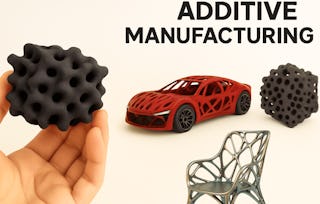
Additive Manufacturing, popularly known as 3D Printing, is one of the digital manufacturing processes and a key enabler of Industry 4.0. This course will introduce the fundamental concepts of different Additive Manufacturing processes. It involves a detailed discussion on the working principles, classifications, process parameters, system architecture, etc.

Essentials of Additive Manufacturing
kurs ist nicht verfügbar in Deutsch (Deutschland)
Wir übersetzen es in weitere Sprachen.

Essentials of Additive Manufacturing
Dieser Kurs ist Teil von Spezialisierung „Digital Manufacturing“

Dozent: Sajan Kapil
Bei enthalten
Verschaffen Sie sich einen Einblick in ein Thema und lernen Sie die Grundlagen.
Stufe Mittel
Empfohlene Erfahrung
Empfohlene Erfahrung
Stufe „Mittel“
At least 1 year of engineering experience at undergraduate level.
3 Wochen zu vervollständigen
unter 10 Stunden pro Woche
Flexibler Zeitplan
In Ihrem eigenen Lerntempo lernen
Verschaffen Sie sich einen Einblick in ein Thema und lernen Sie die Grundlagen.
Stufe Mittel
Empfohlene Erfahrung
Empfohlene Erfahrung
Stufe „Mittel“
At least 1 year of engineering experience at undergraduate level.
3 Wochen zu vervollständigen
unter 10 Stunden pro Woche
Flexibler Zeitplan
In Ihrem eigenen Lerntempo lernen
Kompetenzen, die Sie erwerben
- Kategorie: Process EngineeringProcess Engineering
- Kategorie: Industrial DesignIndustrial Design
- Kategorie: Systems ArchitectureSystems Architecture
- Kategorie: Manufacturing ProcessesManufacturing Processes
- Kategorie: Product EngineeringProduct Engineering
- Kategorie: Manufacturing and ProductionManufacturing and Production
- Kategorie: Mechanical EngineeringMechanical Engineering
- Kategorie: Chemical and Biomedical EngineeringChemical and Biomedical Engineering
- Kategorie: Materials scienceMaterials science
Wichtige Details

Zertifikat zur Vorlage
Zu Ihrem LinkedIn-Profil hinzufügen
Bewertungen
29 Aufgaben
Unterrichtet in Englisch
91%
of learners achieved a positive career outcome
Erfahren Sie, wie Mitarbeiter führender Unternehmen gefragte Kompetenzen erwerben.

Erweitern Sie Ihre Fachkenntnisse
Dieser Kurs ist Teil der Spezialisierung Spezialisierung „Digital Manufacturing“
Wenn Sie sich für diesen Kurs anmelden, werden Sie auch für diese Spezialisierung angemeldet.
- Lernen Sie neue Konzepte von Branchenexperten
- Gewinnen Sie ein Grundverständnis bestimmter Themen oder Tools
- Erwerben Sie berufsrelevante Kompetenzen durch praktische Projekte
- Erwerben Sie ein Berufszertifikat zur Vorlage

In diesem Kurs gibt es 7 Module
Additive Manufacturing popularly known as 3D Printing is one of the digital manufacturing processes and a key enabler of Industry 4.0. This course will introduce the fundamental concepts of different Additive Manufacturing processes. It involves a detailed discussion on the working principles, classifications, process parameters, system architecture, etc.
Das ist alles enthalten
3 Lektüren1 Diskussionsthema
3 Lektüren•Insgesamt 30 Minuten
- Meet Your Instructor - Dr. Sajan Kapil•10 Minuten
- Course Structure and Planning•10 Minuten
- Honor Code•10 Minuten
1 Diskussionsthema•Insgesamt 10 Minuten
- Introduce Yourself•10 Minuten
Additive Manufacturing popularly known as 3D Printing is one of the digital manufacturing processes and a key enabler of Industry 4.0. It is a process of layer-by-layer deposition of material and realizing a 3D object. It can be termed several other names also, based on its application to the manufacturing community. Why additive manufacturing is referred to by different terminology has been discussed in this module. What are the unique capabilities possessed by additive manufacturing and how are they useful in real-life applications have been discussed in this module. Freedom of design, mass customization, waste minimization, and the ability to manufacture complex structures, as well as fast prototyping, are the main benefits of additive manufacturing. In particular, there are some revolutionary applications of AM in biomedical, aerospace, buildings, and protective structures that are discussed in this section. Moreover, based on what criteria the ASTM F42 committee had classified, the AM process is also covered in this module.
Das ist alles enthalten
16 Videos10 Lektüren5 Aufgaben
16 Videos•Insgesamt 98 Minuten
- Different Keywords for Additive Manufacturing•3 Minuten
- Additive Manufacturing (AM)•10 Minuten
- Digital Manufacturing (DM)•9 Minuten
- Rapid Prototyping/Tooling/Manufacturing•13 Minuten
- Geometric Capabilities: Direct assembly•6 Minuten
- Geometric Capabilities: Conformal Cooling Channels, Mass customization, FGMs•9 Minuten
- Material Capabilities•4 Minuten
- Material Capabilities : FGMs, Distinct Objects•6 Minuten
- Vat Photopolymerization•5 Minuten
- Material Jetting•4 Minuten
- Binder Jetting•5 Minuten
- Material Extrusion•5 Minuten
- ASTM Classification: Sheet Lamination•4 Minuten
- ASTM Classification: Powder Bed Fusion; Directed Energy Deposition•6 Minuten
- Motive of ASTM Classification•3 Minuten
- Classification of AM Based on Raw Stock Material•6 Minuten
10 Lektüren•Insgesamt 100 Minuten
- Reference Book: Additive Manufacturing Technologies•10 Minuten
- Reference Article: Additive Manufacturing Technologies: An Overview about 3D Printing Methods and Future Prospects•10 Minuten
- Reference Article: Digital Manufacturing: History, Perspectives, and Outlook•10 Minuten
- Reference Article: Additive Manufacturing: Technology, Applications and Research Needs•10 Minuten
- Reference Article: Additive Manufacturing of Multi-material Structures•10 Minuten
- Reference Article: Materials for Additive Manufacturing•10 Minuten
- The 7 Categories of Additive Manufacturing•10 Minuten
- Reference Article: Additive Manufacturing (3D Printing): A Review of Materials, Methods, Applications and Challenges•10 Minuten
- The 7 Categories of Additive Manufacturing•10 Minuten
- Reference Article: Additive manufacturing (3D Printing): A Review of Materials, Methods, Applications and Challenges•10 Minuten
5 Aufgaben•Insgesamt 90 Minuten
- Basics of AM - Quiz•30 Minuten
- Why to call additive manufacturing! Quiz•15 Minuten
- Capabilities of AM - Quiz•15 Minuten
- Types of AM - Quiz•15 Minuten
- AM - Quiz•15 Minuten
Most liquid-based additive manufacturing systems build parts in a vat of photo-curable liquid resin, an organic resin that cures or solidifies under the effect of exposure to light, usually in the UV range. The light cures the resin near the surface, forming a thin hardened layer. Once the complete layer of the part is formed, it is lowered by an elevation control system to allow the next layer of resin to be coated and similarly formed over it. This continues until the entire part is completed. The vat can then be drained and the part removed for further processing, if necessary. There are variations to this technique by the various vendors and they are dependent on the type of light or laser, method of scanning or exposure, type of liquid resin, and type of elevation and optical system used. Different technologies have been developed based on liquid AM by changing its sub-systems, those commercially available tech parts are discussed in this module. Moreover, a deep insight has been made in water based rapid freezing technology and its working conditions.
Das ist alles enthalten
27 Videos14 Lektüren6 Aufgaben
27 Videos•Insgesamt 161 Minuten
- Introduction to Liquid Based AM•3 Minuten
- Working Principle of Photo-Polymerization•7 Minuten
- Sub-Systems Involved in Photo-Polymerization Based AM(Part-I)•10 Minuten
- Sub-Systems of Photo-Polymerization Based AM (part-II)•8 Minuten
- Classification of Photo-Polymerization Based AM•4 Minuten
- Introduction to Stereo Lithography Apparatus (SLA)•8 Minuten
- Working Principle of SLA•7 Minuten
- Essential Steps Involved in a SLA•6 Minuten
- Laser Curing: Single Bead in SLA•13 Minuten
- Laser Curing: Multi Bead and Multi-Layer in SLA•6 Minuten
- Introduction to a Galvanometer•7 Minuten
- Galvanometer: Beam Correction•8 Minuten
- Recoating Cycle Involved in SLA, Part - I•9 Minuten
- Recoating Cycle - II and Z- axis Setting in SLA•6 Minuten
- Introduction to Perfactory System•5 Minuten
- Different Steps Involved in Perfactory•8 Minuten
- Essential Sub-System of Perfactory: DMD/DLP•7 Minuten
- Essential Sub-System of Perfactory: Voxel•7 Minuten
- Essential Sub-System of Perfactory: Recoating•4 Minuten
- Objet Polyjet•6 Minuten
- Autostrade’s E-Dart•2 Minuten
- Solid Ground Curing (SGC)•8 Minuten
- Microstereolithography•2 Minuten
- Robotic – SLA•2 Minuten
- Two Laser Beam System•4 Minuten
- Volumetrical Stereolithography•1 Minute
- Rapid Freezing Prototyping (RFP)•5 Minuten
14 Lektüren•Insgesamt 140 Minuten
- Reference Book: Rapid Prototyping: Principles and Applications•10 Minuten
- Reference Book: Additive Manufacturing Technologies•10 Minuten
- Reference Book: Rapid Prototyping - Laser-Based and Other Technologies•10 Minuten
- Reference Book: Additive Manufacturing Technologies•10 Minuten
- Reference Book: Rapid Prototyping - Laser-based and Other Technologies•10 Minuten
- Reference Book: Rapid Prototyping - Laser-Based and Other Technologies•10 Minuten
- Reference Article: Recoating Issues in Stereolithography•10 Minuten
- The Section Perfactory Acculas •10 Minuten
- The Section Essential Sub-system of Perfactory: DMD/DLP •10 Minuten
- Reference Book: Rapid Prototyping: Principles and Applications•10 Minuten
- Reference Article: Projection Micro Stereolithography Based 3D Printing and its Applications•10 Minuten
- Reference Article: Projection Micro-Stereolithography Using Digital Micro-Mirror Dynamic Mask•10 Minuten
- Reference Article: A Review of Stereolithography: Processes and Systems•10 Minuten
- Reference Book: Rapid Prototyping: Principles and Applications•10 Minuten
6 Aufgaben•Insgesamt 105 Minuten
- Liquid based AM processes - Quiz•30 Minuten
- Liquid based AM - Quiz•15 Minuten
- What is SLA? - Quiz•15 Minuten
- SLA - Subsystems Quiz•15 Minuten
- Know about Perfactory Acculas- Quiz•15 Minuten
- Photo-Polymerization Based AM - Quiz•15 Minuten
Sheet based additive manufacturing is also known as laminated object manufacturing or sheet lamination, shares similar fabrication principles with other AM processes. But instead of using liquid or powder or wire as feedstock, sheet lamination uses foil to make an object. This AM technique was first demonstrated by Helisys Inc. Different materials can be processed using this sheet lamination technique like paper, composite, and selective metal lamination. In the paper-based lamination, papers/foils are glued together layer by layer and precisely cut to the designed geometry to make the final object. Potentially any sheet material that can be precisely cut using cutting tools like laser, mechanical cutter, etc., and the same can be bonded using adhesive, soldering, brazing, welding, etc., for part construction. The paper thicknesses usually range from 0.07 to 0.2 mm. Composite lamination has a similar principle, but some reinforcement can be added to the buck material to improve the strength of the fabricated part. Rather than adding glue to all over the layer, a binder can be selectively applied in certain locations of that layer to fabricate the part. Different sheet lamination processes had demonstrated in past years which would be discussed in details in this module.
Das ist alles enthalten
14 Videos6 Lektüren5 Aufgaben
14 Videos•Insgesamt 90 Minuten
- Introduction to Sheet Based AM•10 Minuten
- Introduction to Cubic Technologies' LOM•8 Minuten
- Working Principle of Cubic Technologies' LOM•6 Minuten
- Advantages and Limitations of Cubic Technologies' LOM•8 Minuten
- Kira's Paper Lamination Technology, Part- I•5 Minuten
- Kira's Paper Lamination Technology, Part- II•7 Minuten
- Solidimension’s Plastic Sheet Lamination Process•5 Minuten
- CAM-LEM's CL•6 Minuten
- EnnexCorporation’s Offset Fabbers•5 Minuten
- Introduction to Ultrasonic Consolidation (UC)•5 Minuten
- Working Principle of UC•6 Minuten
- Fundamentals of Solid State Bonding•7 Minuten
- Effecting Process Parameters of UC•10 Minuten
- Laminated Manufacturing (LM): Fasteners•2 Minuten
6 Lektüren•Insgesamt 60 Minuten
- Reference Book: Rapid Prototyping: Principles and Applications•10 Minuten
- Reference Book: Additive Manufacturing Technologies•10 Minuten
- Reference Book: Rapid Prototyping: Principles and Applications•10 Minuten
- Reference Book: Rapid Prototyping: Principles and Applications•10 Minuten
- Reference Book: Additive Manufacturing Technologies•10 Minuten
- Reference Article: Friction Stir Additive Manufacturing: Route to High Structural Performance•10 Minuten
5 Aufgaben•Insgesamt 90 Minuten
- Basics of Sheet Based AM - Quiz•30 Minuten
- Cubic LOM - Quiz•15 Minuten
- Paper based Sheet Lamination - Quiz•15 Minuten
- Quiz 1•15 Minuten
- Sheet lamination - Quiz•15 Minuten
This module deals with different AM processes which uses wire as a feedstock material to construct a 3D object. The classifications have been made based on various sub-systems used in wire based AM technology. There are multiple options available as wire material like plastic, wax, composites, and metals; each of the material incorporated in part fabrication required different set of machine arrangement. All commercially available wire based AM process have been covered in this module. Moreover, the function of essential accessories and influence of design parameters are also discussed under individual systems. The most important factors in metal wire based AM technology are omnidirectionality, geometric processing, single bead, multi-bead disposition strategy. All mentioned factors need to be thoroughly studied and planned according to machine environment before starting the material deposition or part fabrication.
Das ist alles enthalten
25 Videos13 Lektüren6 Aufgaben
25 Videos•Insgesamt 164 Minuten
- Classification of Wire Based AM and Introduction to FDM•9 Minuten
- Architecture of a FDM Machine•7 Minuten
- Different Aspects of FDM, Part- I•5 Minuten
- Different Aspects of FDM, Part- II•6 Minuten
- Bead Deposition & Spreading in FDM•7 Minuten
- Bead Ironing and Bonding in FDM•7 Minuten
- Issues Related to Start, Stop, and Turn in FDM•7 Minuten
- Machine Accuracy and Product Quality in FDM•3 Minuten
- Different Wire based AM Processes•8 Minuten
- History of Metal wire AM•10 Minuten
- Introduction to MIG based Wire Arc AM (WAAM)•8 Minuten
- Cold Metal Transfer in WAAM•3 Minuten
- Process Cycle and Geometric Modelling of WAAM•8 Minuten
- Defects Associated with WAAM•11 Minuten
- Machine Kinematics involved in WAAM•8 Minuten
- TIG and Plasma based WAAM, Part- I•6 Minuten
- TIG and Plasma based WAAM, Part- II•5 Minuten
- Introduction to Laser Metal Wire AM•3 Minuten
- Wire Feeding Mechanism in Laser Based System, Part- I•6 Minuten
- Wire Feeding Mechanism in Laser Based System, Part-II•6 Minuten
- Process Parameters involved in Laser Metal Wire AM•8 Minuten
- Working Principle of Electron Beam based Wire AM•4 Minuten
- Different Electron Beam Gun Used in AM•7 Minuten
- Vacuum in Electron Beam AM Systems•6 Minuten
- Challenges in Electron Based AM Systems•4 Minuten
13 Lektüren•Insgesamt 130 Minuten
- Reference Book: Rapid Prototyping - Laser-Based and Other Technologies•10 Minuten
- Reference Book: Rapid Prototyping: Principles and Applications•10 Minuten
- Reference Book: Additive Manufacturing Technologies•10 Minuten
- Reference Article: An Overview of Fused Deposition Modelling (FDM): Research, Development and Process Optimisation•10 Minuten
- Reference Article: Steps Toward a New Classification of Metal Transfer in gas Metal arc Welding•10 Minuten
- Reference Article: A Review of the Wire arc Additive Manufacturing of Metals: Properties, Defects and Quality Improvement•10 Minuten
- Reference Article: Wire Arc Additive Manufacturing of Aluminium Alloys: A Review•10 Minuten
- Reference Article: Weld Bead Modeling and Process Optimization in Hybrid Layered Manufacturing•10 Minuten
- Reference Article: Investigation on Arc Plasma, Droplet, and Molten Pool Behaviours in Compulsively Constricted WAAM•10 Minuten
- Reference Article: A Parametric Study of Inconel 625 Wire Laser Deposition•10 Minuten
- Reference Article: Review on Electron Beam Based Additive Manufacturing•10 Minuten
- Reference Article: Electron beam welding (Vol. 93)•10 Minuten
- Reference Article: Electron-Beam-Additive-Manufacturing-Technology•10 Minuten
6 Aufgaben•Insgesamt 105 Minuten
- Basics of Wire based AM - Quiz•30 Minuten
- FDM - Quiz•15 Minuten
- Wire Deposition Mechanism - Quiz•15 Minuten
- WAAM Quiz•15 Minuten
- WAAM part II - Quiz•15 Minuten
- Electron Based AM - Quiz•15 Minuten
This module deals with powder based additive manufacturing systems or direct energy deposition. Like wire based AM processes here metallic or ceramic powders are used as a feed stock material to realize an object. There are two types of material handling mechanism involved, one is powder-feed on contentious or pulse setting mode and another is powder-bed. Both approaches have its own benefits and limitations. Moreover, there are processes like selective laser sintering (SLS) and selective laser melting (SLM) in which powder gets partially or completely melted and fused together and bonding takes place between powder molecules. The binder-jetting is also a suitable approach for powder based AM. However, powder based AM systems have different set of subsystems as compared to other AM process. These sub-systems are powder metering, conveyance, and delivery, mainly involved in powder feed unit. Different commercially available powder based AM systems has been discussed with proper video demonstration.
Das ist alles enthalten
22 Videos9 Lektüren6 Aufgaben
22 Videos•Insgesamt 149 Minuten
- Classification of Powder based AM•4 Minuten
- Introduction to Powder Feed AM•7 Minuten
- Working Principle of Powder Feed based AM•6 Minuten
- System Level Classifications of Powder Feed based AM•4 Minuten
- Powder Metering / Conveying Systems•9 Minuten
- Off Axis Nozzles•7 Minuten
- Continuous and Discrete Coaxial Nozzles•9 Minuten
- Commercially Available Powder Feed based AM Systems•5 Minuten
- Process Parameters Involved in Powder Feed based AM Systems •7 Minuten
- Applications of Powder Feed based AM Systems•10 Minuten
- Working Principle of Laser Beam Powder Bed AM•5 Minuten
- Essential Sub-Systems, LB-PBAM Part- I•6 Minuten
- Essential Sub-Systems, LB-PBAM Part- II•8 Minuten
- Essential Sub-Systems, LB-PBAM Part- III•6 Minuten
- Introduction to Electron Beam based Powder Bed AM•5 Minuten
- Process Cycles of EB based Powder Bed AM•5 Minuten
- Challenges Associated in the EB based Powder Bed AM•6 Minuten
- Working Principle of Binder Based Powder Bed AM•6 Minuten
- Powder and Ink material Involved in the Process•5 Minuten
- Scanning Systems for the Powder Bed AM•11 Minuten
- Other Sub-systems Involved in the Powder Bed AM•2 Minuten
- Binder Based Powder Bed AM Systems•17 Minuten
9 Lektüren•Insgesamt 90 Minuten
- Reference Article: A Comprehensive Review of the Methods and Mechanisms for Powder Feedstock Handling in Directed Energy deposition•10 Minuten
- Reference Article: A Comprehensive Review of the Methods and Mechanisms for Powder Feedstock Handling in Directed Energy Deposition•10 Minuten
- Reference Book: Rapid Prototyping: Principles and Applications•10 Minuten
- Reference Book: Rapid Prototyping: Principles and Applications•10 Minuten
- Reference Book: Rapid Prototyping - Laser-based and Other Technologies•10 Minuten
- Reference Book: Rapid Prototyping: Principles and Applications•10 Minuten
- Reference Book: Additive Manufacturing Technologies•10 Minuten
- Reference Book: Rapid Prototyping: Principles and Applications•10 Minuten
- Reference Book: Additive Manufacturing Technologies•10 Minuten
6 Aufgaben•Insgesamt 105 Minuten
- Powder based Additive Manufacturing - Quiz•30 Minuten
- Basics of Powder based AM - Quiz•15 Minuten
- Powder Delivery Systems - Quiz•15 Minuten
- Laser Beam in AM - Quiz•15 Minuten
- EB based Powder Bed AM - Quiz•15 Minuten
- Binder based AM - Quiz•15 Minuten
Das ist alles enthalten
1 Lektüre1 Aufgabe
1 Lektüre•Insgesamt 10 Minuten
- Conclusion•10 Minuten
1 Aufgabe•Insgesamt 45 Minuten
- How can you print a prototype? •45 Minuten
Erwerben Sie ein Karrierezertifikat.
Fügen Sie dieses Zeugnis Ihrem LinkedIn-Profil, Lebenslauf oder CV hinzu. Teilen Sie sie in Social Media und in Ihrer Leistungsbeurteilung.
Dozent
von

von

Indian Institute of Technology Guwahati
The Indian Institute of Technology Guwahati is a premier institute engaged in higher education and research in engineering, design, basic sciences, applied sciences, and humanities. It is recognized as an institute of national importance by the Government of India for its overall excellence in teaching and research. IIT Guwahati is regarded as one of the best institutions, distinguished by its commitment to promoting innovation through advanced science and technology.
Mehr von Mechanical Engineering entdecken
 U
UUniversity of Miami
Kurs
 A
AArizona State University
Kurs
 U
UUniversity of Michigan
Kurs
Kurs
Warum entscheiden sich Menschen für Coursera für ihre Karriere?

Felipe M.
Lernender seit 2018
„Es ist eine großartige Erfahrung, in meinem eigenen Tempo zu lernen. Ich kann lernen, wenn ich Zeit und Nerven dazu habe.“

Jennifer J.
Lernender seit 2020
„Bei einem spannenden neuen Projekt konnte ich die neuen Kenntnisse und Kompetenzen aus den Kursen direkt bei der Arbeit anwenden.“

Larry W.
Lernender seit 2021
„Wenn mir Kurse zu Themen fehlen, die meine Universität nicht anbietet, ist Coursera mit die beste Alternative.“

Chaitanya A.
„Man lernt nicht nur, um bei der Arbeit besser zu werden. Es geht noch um viel mehr. Bei Coursera kann ich ohne Grenzen lernen.“
Bringen Sie Ihre Karriere mit einem Online-Abschluss voran.
Erwerben Sie einen Abschluss von erstklassigen Universitäten – 100 % online




Häufig gestellte Fragen
To access the course materials, assignments and to earn a Certificate, you will need to purchase the Certificate experience when you enroll in a course. You can try a Free Trial instead, or apply for Financial Aid. The course may offer 'Full Course, No Certificate' instead. This option lets you see all course materials, submit required assessments, and get a final grade. This also means that you will not be able to purchase a Certificate experience.
When you enroll in the course, you get access to all of the courses in the Specialization, and you earn a certificate when you complete the work. Your electronic Certificate will be added to your Accomplishments page - from there, you can print your Certificate or add it to your LinkedIn profile.
Yes. In select learning programs, you can apply for financial aid or a scholarship if you can’t afford the enrollment fee. If fin aid or scholarship is available for your learning program selection, you’ll find a link to apply on the description page.
Weitere Fragen
Finanzielle Unterstützung verfügbar,